Showing posts with label Tinka Jail Workshops. Show all posts

Jul 30, 2026

National Forensic Sciences University, Ministry of Home Affairs, GOI: Training for prison officers from Mauritius: 30 July, 2026

Delivered a lecture on Case Studies in Correctional Administration: International Best Practices and Reformative Models at the National Forensic Sciences University, Ministry of Home Affairs, Government of India. The session formed part of a two‑week training programme on Correctional Administration designed for prison officers from Mauritius.


During the talk, I highlighted several reformative initiatives undertaken by the Tinka Tinka Foundation in Indian prisons, showcasing innovative practices aimed at communication needs and human dignity in the correctional settings. I also shared insights from my visit to Mauritius prisons in August 2018, undertaken during the 11th Vishwa Hindi Sammelan in Port Louis. These experiences provided a comparative perspective on correctional systems and underscored the importance of cross‑cultural dialogue in advancing prison reforms. 


My talk was primarily focussed on prison radio. Mauritius jails have not introduced this concept yet. I hope the journey of Tinka Tinka inspires them to rewrite a new chapter. Radio in Prison by NBT India and J se Jail by Prabhat Prakashan were also discussed. 

Picture clicked in 2018 in Mauritius during my jail visit


Gratitude: Dr. Minakshi Sinha and Ms. Garima Puri

Jun 6, 2026

3-DAY Certificate Course on AUDIO PRODUCTION & PODCASTING: Last Date for Registration: 12th June


TINKA TINKA FOUNDATION 

is organising a

3-DAY Certificate Course as a part of

Tinka Tinka Paathshala on 

AUDIO PRODUCTION & PODCASTING

Date: 16 June to 18 June 2026 | Time: 4:30 pm to 8:30 pm

Hours: 12

Mode: Online

Fee: ₹1200/

Trainers: Top media professionals

Participants: Anyone

Age: 15 years and above

Participants will be given a certificate of participation after the successful  completion of the course. 3 best participants will receive a special Letter of Appreciation along with 2 books on prison reforms.

Registration Link: 

Last Date for Registration: 12 June

......................

Organiser: 

Professor (Dr.) Vartika Nanda

Founder, Tinka Tinka Foundation

Who we are: www.tinkatinka.org/ Professor (Dr.) Vartika Nanda – Tinka Tinka Prison Reforms

Contact: tinkatinkaorg@gmail.com/ 9811201839

Google Form: Tinka Tinka Foundation: Audio Production & Podcasting Course: 2026

GooglePay:  


Apr 26, 2026

Rajdhani College: Seminar: 25 April, 2026

हिंदुस्तानी भाषा अकादमी, तिनका तिनका फाउंडेशन एवं राजधानी कॉलेज (दिल्ली विश्वविद्यालय) के संयुक्त तत्त्वावधान में आयोजित संगोष्ठी 

"डिजिटल मीडियाः चुनौतियां, प्रभाव और सामाजिक उत्तरदायित्व"

 शनिवार, 25 अप्रैल 2026

समयः प्रातः 10 बजे

स्थानः सभागार, राजधानी कॉलेज, राजा गार्डन, महात्मा गांधी मार्ग नई दिल्ली 

Apr 4, 2026

संगोष्ठी: हिंदुस्तानी भाषा अकादमी, तिनका तिनका फाउंडेशन और राजधानी कॉलेज (दिल्ली विश्वविद्यालय) : 25 April, 2026

हिंदुस्तानी भाषा अकादमी, तिनका तिनका फाउंडेशन एवं राजधानी कॉलेज (दिल्ली विश्वविद्यालय) के संयुक्त तत्त्वावधान में आयोजित संगोष्ठी 

"डिजिटल मीडियाः चुनौतियां, प्रभाव और सामाजिक उत्तरदायित्व"

 शनिवार, 25 अप्रैल 2026

समयः प्रातः 10 बजे

स्थानः सभागार, राजधानी कॉलेज, राजा गार्डन, महात्मा गांधी मार्ग नई दिल्ली 

उप-विषयः

•लोकतंत्र में मीडिया की भूमिका और जिम्मेदारी

•सोशल मीडिया और बदलता सामाजिक ताना-बाना

•निष्पक्ष पत्रकारिता और विश्वसनीयता का संकट

•फेक न्यूज, दुष्प्रचार और समाज पर इसका प्रभाव

•डिजिटल युग में मीडिया साक्षरता और नैतिक चुनौतियाँ 

Mar 13, 2026

Online Poster Presentation on “Women & the Society” : 13 March, 2026

Event Report: Online Poster Presentation on “Women & the Society”

An online poster presentation on “Women & the Society” was organised by Tinka Tinka Foundation on 13th March, 2026, to encourage meaningful academic engagement with issues related to gender, social justice, and women’s rights.

The event provided a platform for participants from different academic backgrounds to present research-based and creative poster work addressing diverse dimensions of women’s experiences in society. The presentation aimed to promote critical dialogue, visual communication, and sensitivity towards structural inequalities affecting women.

A number of entries were received following the call for submissions, out of which six posters were selected for presentation during the online session. The selected participants presented their work before the organisers, highlighting themes related to gender awareness, representation, rights, and social challenges.

The event also contributed to strengthening research orientation and presentation skills among participants while creating space for interdisciplinary discussion on contemporary social concerns. Certificates are provided to the selected participants, and their work is added here for wider recognition through the foundation’s platform.

Dr. Devender Kakkar (Retd Faculty , Delhi University), Jaideep Karnik (Head, Digital Media, Amar Ujala), Nitin (bureaucrat) and Professor Vartika Nanda were the jury. We are sharing the selected posters here.

1. Harpreet Kaur from Punjabi University, Patiala


2. Pooja Goswami, Hansraj College, University of Delhi

3. Gagandeep Kaur, Sri Guru Tegh Bahadur Khalsa College, University of Delhi

4. Tanzida Parvez Oishe, Lady Shri Ram College, University of Delhi

5. Muskan Giri, Lady Shri Ram College, University of Delhi

6. Indrani Bhadra, Guru Gobind Singh Indraprastha University, Delhi 

Mar 1, 2026

Online Poster Presentation on “Women & the Society” : 8 March, 2026

Tinka Tinka Foundation is organising an Online Poster Presentation focused on Women & the Society, to encourage meaningful dialogue, research, and awareness around gender issues and social justice.

Key Dates

 • Last Date for Submission & Registration: 8th March

 • Notification of Acceptance: 10th March

 • Poster Presentation: 13th March

 • Mode: Online

Who Can Participate?

• Undergraduate Students

• Postgraduate Students

• Research Scholars

• Practitioners

Registration Fee: ₹200

Perks

• Certificates for all participants

• Selected posters will be featured on the Foundation’s website

For queries:

Email: tinkatinkaorg@gmail.com

Phone: 9811201839

This is a great opportunity to contribute to conversations that matter and showcase your research and creative expression.


Feb 24, 2026

21 Feb, 2026: State Women’s Commission, Madhya Pradesh & TTF: Central Jail, Jabalpur (Madhya Pradesh)

 Introduction:

On 21 February, 2026, the State Women’s Commission, Madhya Pradesh in collaboration with the Tinka Tinka Foundation organised a special visit and interaction at the historic Netaji Subhash Chandra Bose Central Jail, Jabalpur.

Built in 1854, this prison is among the oldest in India and stands as a living archive of colonial history, freedom struggle memories, and contemporary reform practices. The visit offered a deep engagement with the jail’s legacy, infrastructure, industries, and the lived realities of its inmates.


State Women’s Commission, Madhya Pradesh and Tinka Tinka Foundation
Written by Professor Vartika Nanda
History, Reform and Resilience at Netaji Subhash Chandra Bose Central Jail, Jabalpur

Date: 21 Feb, 2026
Introduction: On 21 February, 2026, the State Women’s Commission, Madhya Pradesh in collaboration with the Tinka Tinka Foundation organised a special visit and interaction at the historic Netaji Subhash Chandra Bose Central Jail, Jabalpur.
Built in: 1854
Capacity: 2803
On 21 Feb, 2026: Approximately 1800 men and 60 women, 5 on death row
Built in 1854, this prison is among the oldest in India and stands as a living archive of colonial history, freedom struggle memories, and contemporary reform practices. The visit offered a deep engagement with the jail’s legacy, infrastructure, industries, and the lived realities of its inmates.
A Jail Steeped in History: As one enters the premises, a wooden sofa crafted in 1854 still occupies space — functional and preserved across generations. 

The Jail Units: The prison is divided into five functional units:
Poorvi Khand, Paschimi Khand, Aazad Hind Khand, Mahila Khand, and the Jail Hospital, along with an isolation centre.
Reform through Industry and Education: Despite its long colonial  background, the jail today functions as a centre of productivity and rehabilitation. Its industries include weaving units, idol-making, printing press, masala production centre, jail school and IGNOU classes for higher education. These initiatives equip inmates with employable skills and academic qualifications, strengthening prospects for reintegration.Industry: Weaving, idol making, printing press, masala center, jail school, IGNOU classes. 
The Phansi Ghar: A Stark Reminder of Justice: The jail contains a functioning execution chamber — one of the few in Madhya Pradesh, that include such arrangements in Sagar and Indore.
The execution board (takhta) can accommodate up to three inmates at a time.
A rope brought from Buxar, Bihar, was historically used for execution.
A rehearsal dummy is maintained for procedural  execution.
A narrow railway track was used to carry the body post-execution.
Last execution carried out here was in 1997, when Kanta Prasad from Shahdol was hanged. This place is a reminder of capital punishment in the justice system. 
Jurassic Park: Children of inmates, living with them in the jail, are occasionally given an access to a recreational space informally known as “Jurassic Park,” where they occasionally enjoy supervised pool gatherings termed as POOL PARTY- a small but meaningful attempt to preserve childhood within confinement.
The jail kitchen:  Over 100 year old jail kitchen continues to prepare meals for the large inmate population. Despite overcrowding challenges in earlier decades, the system today operates in capacity limits.
Food quality is checked daily by the Deputy Jailor, who tastes the meals before they are served — a practice reflecting accountability and care.
Subhash Chandra Bose Ward: The Legacy of Subhash Chandra Bose: This jail derives its name from Netaji Subhash Chandra Bose, who was imprisoned here twice — in 1931 and again in 1933. Visitors are taken to the ward where he stayed. Outside, a placard mentions the exact dates of his incarceration. This ward houses rare memories including:
The original sleeping platform used during that era
Copies of letters written by Bose from Vienna to the then Superintendent of the jail, Shri Deshpandey
A preserved admission register bearing historical entries
A tijori (safe) made in 1882
A bell installed in 1933
A CCTV camera over 30 years old, displayed as part of the jail’s technological evolution
Artefacts recovered during excavations near the premises
Three years ago, members of Bose’s family visited the jail to see the ward and to pay their homage. 
Subhadra Ward: Renowned freedom fighter and poet Subhadra Kumari Chauhan was imprisoned here from 11 August 1942 to 1 May 1944. A large placard commemorates her stay, and the ward has been named in her honour. Her presence links the jail not only to political resistance but also to literary courage and women’s participation in India’s freedom movement.
Among the women inmates, Savitri (2012), Pyari Bai (2015), and Preeti (2016) are among the longest-incarcerated residents, each full of her own untold narratives. Women inmates spend their daytime hours on the ground floor, while the first-floor barracks remain locked.
Reflections from the Visit: The collaboration between the State Women’s Commission and Tinka Tinka Foundation underscored a shared commitment to documenting prison realities, strengthening communication-based reform, and ensuring dignity within incarceration spaces.
The visit to Netaji Subhash Chandra Bose Central Jail, Jabalpur, was not merely an institutional tour- it was a journey through India’s layered history of colonial resistance, criminal justice, and correctional reform.
The visit highlighted a powerful contrast: A prison that holds memories of freedom fighters and execution chambers, yet simultaneously runs classrooms, industries, and spaces for children’s laughter.
In its corridors echo stories of struggle, punishment, reform, and resilience — stretched across 172 years of existence. Within its old walls stand relics of the past and signs of transformation. From Bose’s letters to IGNOU classrooms, from the phansi ghar to weaving units — the jail reflects the evolving philosophy of incarceration in India: punishment intertwined with possibility.
Gratitude: 
Suresh Tomar, Secretary, State Women’s Commission, Madhya Pradesh
Akhilesh Tomar, Jail Superintendent
Madan Kamlesh, Deputy Superintendent
Rupali Sharma, Deputy Superintendent
Sarita Gharu, Welfare Officer
Dev Kumari Pageche, Matron
Gratitude:
श्री अखिलेश तोमर, जेल अधीक्षक
श्री मदन कमलेश,  उप अधीक्षक
श्रीमती रुपाली शर्मा,उप अधीक्षक
श्रीमती सरिता घारू,  कल्याण अधिकारी 
 श्रीमती देव कुमारी पागेचे,  मैट्रन
………

Feb 17, 2026

Workshop: Observation Home for Boys: Government of Delhi & Tinka Tinka Foundation: 17 February, 2026

17 February, 2026: Creative Expression for Mental Well-being: An observation home in Delhi

The Tinka Tinka Foundation organized a workshop on “Mental Health through Communication and Creative Skills” at Adharshila Observation Home for Boys-II on 17 February in Delhi. The event, themed “Vande Mataram,” was designed to promote emotional expression and well-being through creative engagement.

Dec 26, 2025

Real Stories of Betrayal and Survival | Inside Delhi’s GB Road: Vartika Nanda: Brut: 22 December, 2025:


22 December, 2025: Brut: Journalist Vartika Nanda went into the narrow lanes of GB Road to understand what life looks like behind closed doors.

Several women recount being misled or betrayed by their lovers or abandoned by their families before arriving there. Many do not reveal their age, and some say they had no option but to live there to make a living.

This story focuses on their living conditions, personal accounts, and the realities behind doors that are rarely opened to the public.

Oct 22, 2025

29 September, 2025: Tinka Tinka Foundation and Delhi Police: GB Road: Workshop on Mental Health

 29 September, 2025 

Tinka Tinka Foundation organised a workshop at the Women's Police Station on G.B. Road, Delhi, to address the ‘mental health issues of women sex workers through art and creativity’ This was achieved through a unique art and clay modeling workshop, involving 30 sex workers and 10 children. The objective of this workshop was to bring hope and help in creating a better life to one of the city's most vulnerable communities.

तिनका तिनका फ़ाउंडेशन ने दिल्ली के जी.बी. रोड स्थित महिला पुलिस चौकी पर यौनकर्मियों के मानसिक स्वास्थ्य से जुड़े मुद्दों को कला और रचनात्मकता के माध्यम से संबोधित करने के लिए एक कार्यशाला का आयोजन किया।


यह लक्ष्य 30 यौनकर्मियों और 10 बच्चों की भागीदारी वाली एक अद्वितीय कला और मिट्टी के मॉडल बनाने की कार्यशाला के ज़रिए हासिल किया गया। इस कार्यशाला का उद्देश्य शहर के सबसे कमज़ोर समुदायों में से एक के लिए आशा लाना और एक बेहतर जीवन बनाने में मदद करना था।


जब ये महिलाएं अपनी उंगलियों से रंगों को छूती हैं और मिट्टी को आकार देती हैं तो उनके चेहरे पर सालों बाद सहज खुशी नजर आती है.  इस वर्कशॉप की एक और खास बात रही. यहां इन महिलाओं के साथ उनके बच्चे भी आए थे. बच्चों ने जो हुनर पेश किया, वो देखने लायक था, उम्मीद से परे था. 


बच्चों ने कर दिया था कमाल  

दरअसल, दिल्ली पुलिस इन बच्चों के लिए स्तंभ की तरह खड़ी है. हालिया, गर्मियों की छुट्टियों के वक्त इन बच्चों के लिए एक महीने का विशेष कैम्प आयोजित किया गया था. यहां उन्हें चिकनी मिट्टी से खिलौने बनाने का प्रशिक्षण दिया गया. अब ये बच्चे हर शाम इसी चौकी की पहली मंजिल पर आते हैं. या तो इन बच्चों को यहां प्रशिक्षण मिलता है या ये नियमित तौर पर पढ़ाई करते हैं. 


आखिर कौन हैं ये महिलाएं जो अपनी पहचान छिपाकर जीती हैं?

इनमें से ज्यादातर महिलाएं गरीबी, बेरोजगारी और शिक्षा की कमी जैसी मजबूरियों के कारण यहां तक पहुंची हैं. कुछ ऐसी हैं जिन्हें धोखे से यहां लाकर बेच दिया गया. इसके बाद उनके परिवार के रास्ते हमेशा के लिए बंद हो गए. समाज और परिवार ने उन्हें कभी स्वीकार नहीं किया.

इन्हीं में से एक शिल्पा (बदला हुआ नाम) ने अपनी पीड़ा सुनाई. उसने बताया कि वह हर साल अपने घर जाती है, परिवार से मिलती है, लेकिन कभी नहीं बताती कि वह क्या काम करती है. उसने अपने घर पर बता रखा है कि वह दिल्ली में एक ट्रांसपोर्ट कंपनी में काम करती है. अपना दुख बताते हुए शिल्पा की आंख में आंसू आ जाते हैं. वह इसके लिए खुद को ही कोसती है. शिल्पा कहती है शायद पिछले जन्म में उसने कोई पाप किए होंगे जिसकी सजा वह अब भुगत रही है. शिल्पा की आंखों में घर लौटने की चाहत है. लेकिन वह बेबस और लाचार है.  

उम्मीद की एक रोशनी 

दिल्ली पुलिस की सब-इंस्पेक्टर किरण सेठी इन महिलाओं के लिए जिंदगी में एक रोशनी बनकर आई हैं. वह इस चौकी की इंचार्ज हैं. किरण सेठी कहती हैं, "जब से मैं यहां चौकी इंचार्ज बनी हूं, मेरा मकसद इन महिलाओं को समय-समय पर यहां बुलाकर उनके शारीरिक और मानसिक स्वास्थ्य के लिए कुछ प्रशिक्षण आयोजित करना है. मैं खुद भी इनके कोठों में जाकर इनकी स्थिति का जायजा लेती रहती हूं."


किरण सेठी की मेहनत के नतीजे आने भी शुरू हो गए हैं. हाल ही में उन्होंने पूनम नाम की एक सेक्स वर्कर को इस दलदल से रिहा कराया. उसे एक ई-रिक्शा भी दिलाया ताकि वह एक सम्मानजनक जिंदगी शुरू कर सके. किरण सेठी पर 'किस्सा खाकी का' एक अंक प्रसारित हो चुका है. दिल्ली पुलिस की इस स्पेशल पॉडकास्ट सीरीज का नाम 'किस्सा खाकी का' है.  

Kissa Khaki Ka: Full Episode 9: Podcast Delhi Police: किस्सा खाकी का: Ujala Bikhertee Kiran - YouTube

जीबी रोड के बारे में जानिए

जीबी दिल्ली का एक इलाका है जिसका आधिकारिक नाम श्रद्धानंद मार्ग है. जीबी रोड को मुख्य रूप से दिल्ली में देह व्यापार के इकलौते और सबसे बड़े केंद्र के रूप में जाना जाता है. यहां करीब 1000 महिलाएं रहती हैं, जिनमें से अधिकांश अपनी पहचान छिपाकर काम करती हैं. 

जीबी रोड की मिट्टी क्यों है खास?

जीबी रोड जैसी जगहों की की मिट्टी की एक अनूठी महिमा है. कहा जाता है कि दुर्गा पूजा की मूर्तियां बनाने के लिए ऐसी जगहों की मिट्टी को शुभ मानकर इस्तेमाल में लाया जाता है. इस मिट्टी की महिमा की बात तो खूब होती है, लेकिन इस जगह पर रहने वाली महिलाओं के उद्धार के लिए काम करने वाली संस्थाएं न के बराबर हैं. 


यह जरूरी है कि इन महिलाओं को केवल काउंसलिंग नहीं, बल्कि किसी स्थायी समाधान के रूप में यहां से बाहर निकालने का प्रयास किया जाए. अगर सही दिशा में काम हो तो इनमें से कुई महिलाएं वापिस अपनी एक बेहतर जिंदगी में लौट सकती हैं.  पुलिस और तिनका तिनका फाउंडेशन का यह प्रयास भविष्य में भी जारी रहगा. आपको यह भी बता दें कि आने वाले दिनों में तिनका तिनका यहां एक और वर्कशॉप करेगा, जिसमें महिलाओं की नई टोली इसका हिस्सा बनेगी. थी हूं और रहूंगी पॉडकास्ट का अगला अंक भी यहीं की एक महिला पर आधारित रहेगा.

References:

1. Dr. Vartika Nanda’s website: https://vartikananda.com/

2.Tinka Tinka Prison Reforms’ Website: http://tinkatinka.org/ 

3.Dr. Vartika Nanda’s Blog: https://vartikananda.blogspot.com/

4.Podcast | GB Road, Delhi | Year 2025:Thee. Hoon.. Rahungi...। थी.हूं..रहूंगी...Ep 10 । G B Road। Sex Workers। Vartika Nanda

5. Podcast | GB Road, Delhi | Year 2024:Thee Hoon Rahungi। थी.हूं..रहूंगी...Ep 2 । Hope and Courage। GB Road, New Delhi । Vartika Nanda

6.Delhi Police Podcast Series: Kissa Khaki Ka: Kissa Khaki Ka - किस्सा खाकी का

In Press:

1.NDTV: 22 October, 2025: Gloomy walls of GB Road of National Capital Delhi - Uplifting sex workers' mental health via art along with Delhi Police

2. ABP NEWS: 24 October, 2025:  https://www.abplive.com/podcasts/samwaad/delhi-gb-road-delhi-police-new-initiative-know-details-from-dr-vartika-nanda-3033010

3. VN Ki Paathshala: 26 January, 2026: VN Ki Paathshala। GB Road। दिल्ली। Workshop। Mental Health। Kiran Sethi। Professor Vartika Nanda - YouTube

Date: 29 September, 2025: The melancholic walls of G.B. Road, where colors of hope are now blossoming: Professor Vartika Nanda

​In Delhi, the nation's capital, marked by heavy traffic and a hurried pace, some stories remain hidden amidst the noise. This is the story of a part of Delhi we call G.B. Road. G.B. Road is a center for sex work where over 1,000 women live, concealing their identities. These women have no connection to an ordinary colorful life. However, change is slowly arriving here too. A ray of hope is becoming visible. In this sequence, a unique gathering was recently held on the first floor of a Women's Police Station situated amidst the narrow lanes of G.B. Road.


Healing through Art and Color

Today, 50-year-old Shilpa (name changed) has arrived on the first floor of the police station accompanied by about thirty other women. In this room, there is no fear of the police. In front of her, there are boxes of colors and clay for making shapes. These women have been asked to choose their favorite colors and create figures according to their imagination. This is not just an art workshop, but a unique initiative focusing on mental health, organized by Tinka Tinka Foundation, Shri Rajiv Goel, and Delhi Police. The aim of this workshop is to bring these women out of the dullness and pain of their lives and connect them with the world of art and creation.

Successful Workshop with the children of GB Road

When these women touch the colors with their fingers and give shape to the clay, a spontaneous happiness appears on their faces. There was another special feature of this workshop. The children of these women also came along. The skill the children displayed was remarkable, way beyond expectations.

Delhi Police stands as a pillar of support for these children. Recently, a special month-long camp was organized for them during the summer holidays, where they were taught to make toys with clay. Now, these children come to the first floor of this very police station every evening. Here, they either receive training or they engage in regular studies.


Who exactly are these women who live by concealing their identities?

Most of these women have ended up here owing to compulsions like poverty, unemployment, and lack of education. Some were deceived and brought here to be sold. After that, the doors to their families were permanently closed. Society and family never accepted them.

Among them, a woman, Shilpa (name changed), shared her pain. She revealed that she goes home every year and meets her family, but she never reveals to them what work she actually does. She has told her family that she works for a transport company in Delhi. As she shared her sorrow, tears welled up in Shilpa's eyes. She blames herself for her situation. Shilpa says perhaps she committed some sins in a past life, for which she is now paying the price. There is a longing to return home in Shilpa's eyes, but she is helpless and constrained.

A Ray of Hope

Sub-Inspector Kiran Sethi of the Delhi Police has become a beacon of light in the lives of these women. She is the in-charge of this police post. Kiran Sethi says, "Ever since I became the police station in-charge here, my aim has been to call these women here from time to time and organise some training for their physical and mental health. I also visit their brothels myself to assess their situation."


The results of Kiran Sethi's efforts have also started to appear. Recently, she successfully rescued a sex worker named Poonam from this quagmire. She also helped her get an e-rickshaw so that she could start a respectable life. An episode about Kiran Sethi has been aired on 'Kissa Khaki Ka'. The name of this special podcast series by the Delhi Police is 'Kissa Khaki Ka'. 

Kissa Khaki Ka: Full Episode 9: Podcast Delhi Police: किस्सा खाकी का: Ujala Bikhertee Kiran - YouTube

Where is G.B. Road?

G.B. Road is an area in Delhi whose official name is Shradhanand Marg. G.B. Road is primarily known as the sole and largest center for sex work in Delhi. Around 1,000 women reside here, most of whom work while concealing their identities.

Why is the Soil of G.B. Road Special?

The soil from places like G.B. Road holds a unique significance. It is believed that the clay from such places is considered auspicious and used for making idols of Goddess Durga for Durga Puja. While the glory of this clay is much discussed, there are very few organizations working for the upliftment of the women living in this area.

Continued Efforts Towards a Better Future

It is necessary that these women are not only offered counselling but efforts are made to bring them out of this place as part of a permanent solution. If work is done in the right direction, many of these women can return to a better life. The efforts of the Police and the Tinka Tinka Foundation will continue in the future as well. Tinka Tinka will conduct another workshop here soon, in which a new batch of women will participate. The next episode of the 'Thi, Hoon, Aur Rahoongi' podcast will also be based on a woman from this very area.

References:

1. Dr. Vartika Nanda’s website: https://vartikananda.com/

2.Tinka Tinka Prison Reforms’ Website: http://tinkatinka.org/ 

3.Dr. Vartika Nanda’s Blog: https://vartikananda.blogspot.com/

4.Podcast | GB Road, Delhi | Year 2025:Thee. Hoon.. Rahungi...। थी.हूं..रहूंगी...Ep 10 । G B Road। Sex Workers। Vartika Nanda

5. Podcast | GB Road, Delhi | Year 2024:Thee Hoon Rahungi। थी.हूं..रहूंगी...Ep 2 । Hope and Courage। GB Road, New Delhi । Vartika Nanda

6.Delhi Police Podcast Series: Kissa Khaki Ka: Kissa Khaki Ka - किस्सा खाकी का

In Press:

1.NDTV: 22 October, 2025: Gloomy walls of GB Road of National Capital Delhi - Uplifting sex workers' mental health via art along with Delhi Police

2. ABP NEWS: 24 October, 2025: https://www.abplive.com/podcasts/samwaad/delhi-gb-road-delhi-police-new-initiative-know-details-from-dr-vartika-nanda-3033010

Jul 19, 2025

17 July, 2025: Central Jail, Bhopal: “Voices Unlocked: Women Inmates Discover the Power of Communication” in Central Jail, Bhopal

 17 July, 2025: Voices Unlocked: Healing Through Expression in Central Jail, Bhopal 

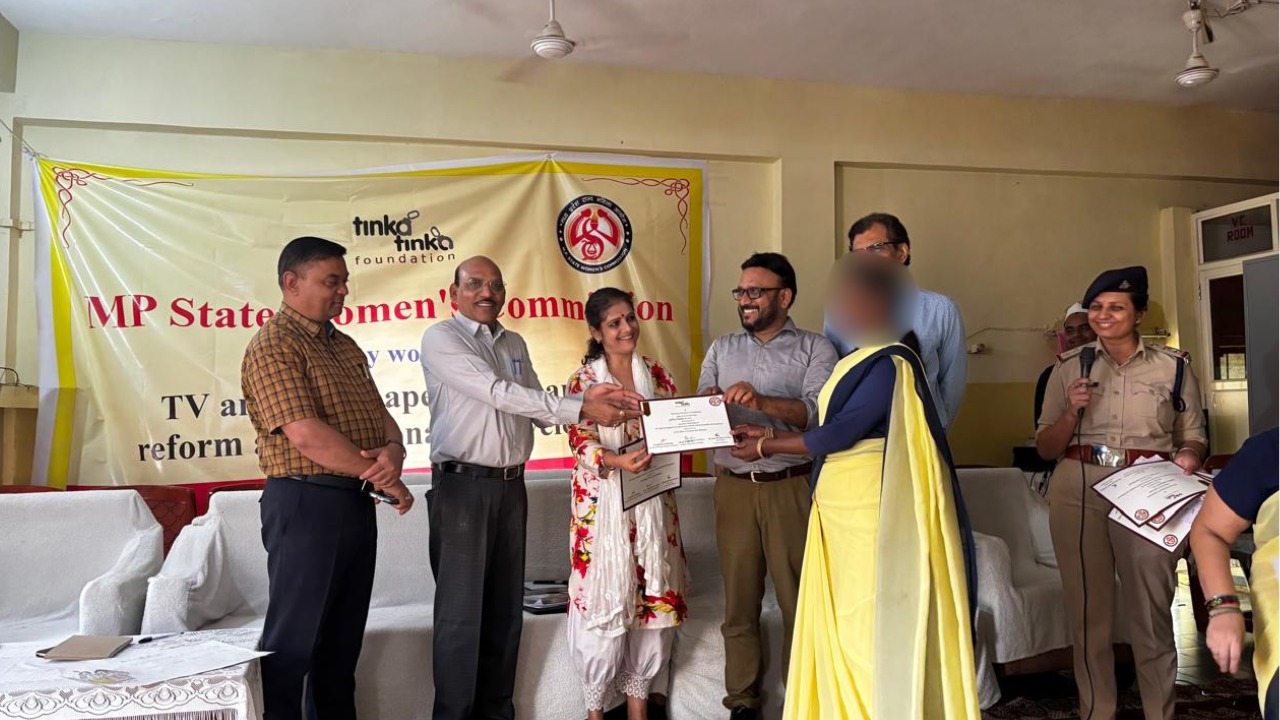
Introduction: On the eve of Nelson Mandela Day on 17 July, 2025, the Madhya Pradesh State Women’s Commission, in collaboration with the Tinka Tinka Foundation, organised a one-day communication and creativity workshop titled “Voices Unlocked: Women Inmates Discover the Power of Communication” at Central Jail, Bhopal. The objective of the initiative was to help women inmates express themselves through art, media, and storytelling, transforming silence into self-awareness and healing. Out of 200 inmates, 115 participated in initial discussions, and 50 were selected for focused training sessions that used TV and newspapers as tools for reform and personality development. The workshop featured stories like Anjani’s, a transgender inmate who rediscovered her dream of becoming a fashion designer, and Rajni’s, a 62-year-old who learned to read and found peace through art. Women expressed their emotions through paintings on themes such as “Dreams in Jail”. According to Member Secretary Suresh Tomar, the Commission plans to expand such skill and communication development programmes across other prisons in Madhya Pradesh. Through this initiative, organisers demonstrated how communication and creativity can serve as powerful tools for rehabilitation and dignity in prisons.

Gratitude: Suresh Tomar, Secretary, MP State Women's Commission,  M R Patel,  (DIG, Jail),  Rakesh Bhangre (Superintendent, Central Jail, Bhopal) and Praveen Gangrade ( Director Anand Department)

“Voices Unlocked: Women Inmates Discover the Power of Communication” in Central Jail, Bhopal

- Learning to Speak: Basics of Communication as Therapy

- A Day of Discovery: From Silence to Self-Awareness

- Madhya Pradesh State Women’s Commission in collaboration with the Tinka Tinka Foundation, celebrate creativity in jail. 

Anjani’s Dream Woven in Color and Courage

At 35, Anjani had one dream: to become a fashion designer. She filled out her application forms with hope, but when the institute learned she was from the transgender community, her form was rejected—her identity overshadowing her aspirations. Today, within the walls of Bhopal Central Jail, that dream has found new life.

Here, in a place where society often sees as the end, Anjani has found a beginning. “Outside, we face discrimination but inside these walls, I’ve found the freedom to learn,” she said. The jail, once a symbol of confinement, has become a space of possibility—offering her the education and encouragement she was denied on the outside. Her story is not just about fashion. It’s about dignity, resilience, and the power of second chances. Anjani stood tall among a crowd of women inmates, clutching a painting she had created—a vivid reflection of her dreams. With quiet strength and unwavering resolve, she declared, “I want to be a fashion designer.”

Rajni’s Journey: From Silence to Solace

At 62, Rajni’s story is one of quiet transformation. When she entered Bhopal Central Jail in 2005 as a convict, she was illiterate—unable to read or write, and burdened by the weight of her past but here, in the jail, she discovered something unexpected: peace.

Over the years, Rajni learned to read, to express herself, and most importantly, to find happiness. “Jail gave me something I never had outside—solace,” she said softly, her eyes reflecting years of introspection.

Rajni shared her journey through art. She held up a painting she had created—featuring a Tulsi plant and a glowing moon at its centre. The Tulsi, sacred and healing; the moon, serene and constant. Together, they symbolized her newfound faith and inner calm. Her story is a testament to the power of learning, healing, and spiritual growth—even in the most unlikely places.

Expressions Behind Bars: Stories of Hope from Bhopal Central Jail in Madhya Pradesh

These expressions were made by women prisoners in a special one-day workshop on TV and newspapers as a means of reform and personality development in the women's ward of Central Jail, Bhopal. This was organised by Madhya Pradesh State Women’s Commission in collaboration with the Tinka Tinka Foundation, on the eve of Nelson Mandela Day.

The exercise: Out of 200 women inmates in the jail, 115 were chosen for a discourse, later selecting a group of 50 women for the specialised workshop. The workshop was designed to address the communication needs of women inmates, helping them articulate their inner worlds through visual and verbal storytelling. From dreams to regrets, from aspirations to affirmations, the women used media as a mirror to reflect their evolving selves. 


What women inmates expressed and the outcome: Women expressed their mental and emotional state through vibrant paintings on themes like dreams in jail etc, topics that have been dealt by Tinka Tinka Foundation in the past as apart of the annual awards given by them. These artworks became more than just creative exercises—they were windows into their inner worlds, tools for healing, and steps toward reclaiming their identities. 

The workshop resulted in transforming the space into a canvas of dreams, resilience, and self-expression. The workshop carefully focused on the communication needs of women prisoners—a critical yet often overlooked aspect of rehabilitation. Through the mediums of TV and newspapers, the initiative aimed to foster personality development and prepare inmates for future employment.

These expressions weren’t just artistic—they were therapeutic.  Even the illiterate women inmates came forward to express themselves with confidence. Rami, an inmate said, “ this was the best day in the jail, since I have come here. I am thrilled that I could express myself in such a unique manner.”

What the organisers felt: Member Secretary of the Commission, Suresh Tomar, emphasized the long-term vision behind such efforts. “The Commission has been organizing various programmes for skill development of women prisoners, and these initiatives will continue,” he said. “We will make continuous efforts for the upliftment of women and will soon conduct skill development programmes for women inmates in other jails. ”

Together, these voices—spoken and painted—signal a new chapter in rehabilitation: one where communication becomes a bridge to dignity, growth, and reintegration.


Professor Vartika Nanda, Head, Department of Journalism, Lady Shri Ram College, Delhi University and Founder, Tinka Tinka Foundation said, “ Tinka Tinka Foundation is credited to introduce journalism in jails. This exercise is another step in this direction. We want to impart basic skills in these women, give them the opportunity to fill their empty time with something meaningful, provide them a purpose and address their communication needs. By doing so, we are able to also cater to their mental health. Today’s exercise has once again proved that incarcerated women must be given such platforms so that they are able to live a life of purpose and dignity.” 

Jail Superintendent Rakesh Bhangre gave unwavering support to the entire exercise. He said, “ We have seen several organisations visiting us in the past but very few go deeper into the prison life and offer remedies for improving living conditions of inmates. I would say, today’s exercise has been a powerful step in fulfilling this.” 

 DIG jail M R Patel, Director and Anand Department Praveen Gangrade were also present during the event.

Background: Tinka Tinka Foundation is widely recognised for its seminal work in the form of a unique coffee table book- Tinka Tinka Madhya Pradesh- which was released by Shri Kiren Rijuji, then Minister of State for Home Affairs in 2018. This book stands out as an authentic documentation of prison life, capturing the lived experiences of 19 participants—including 12 male inmates, 2 female inmates, 4 children residing with their mothers in jail, and one prison guard (prahari). Through vivid visuals and personal narratives, the book offers a rare and intimate glimpse into the emotional, social, and psychological dimensions of incarceration. Her  "Study of the condition of women inmates and their children in Indian Prisons and their communication needs with special reference to Uttar Pradesh" was been evaluated as OUTSTANDING by ICSSR and was released by Manoj Kumar Singh (IAS), Chief Secretary, Uttar Pradesh in 2024. 

......................................................................................................................................................

Press Release in Hindi

सेंट्रल जेल, भोपाल: सपनों और साहस की चित्रशाला बनी जेल

नेल्सन मंडेला दिवस की पूर्व संध्या पर, भोपाल की सेंट्रल जेल में एक परिवर्तनकारी पहल सामने आई, जिसे मध्य प्रदेश राज्य महिला आयोग और तिनका तिनका फाउंडेशन ने मिलकर आयोजित किया। इस एक दिवसीय विशेष कार्यशाला में 115 महिला बंदियों ने भाग लिया, जिसमें से 50 को मीडिया, संप्रेषण और व्यक्तित्व विकास पर आधारित विशेष सत्र के लिए चुना गया।

📚 कला, कहानी और आत्म-अभिव्यक्ति का संगम

कार्यशाला का उद्देश्य था – बंदियों की संवादात्मक ज़रूरतों को समझना और उन्हें अपनी भावनाओं, सपनों और पछतावे को शब्दों और रंगों में पिरोने का मंच देना। टीवी, अख़बारों और पेंटिंग्स की सहायता से उन्होंने अपनी पहचान और आत्म-खोज को अभिव्यक्त किया।

🎨 अंजनी की कहानी: रंगों में बुना सपना

35 वर्षीया अंजनी, ट्रांसजेंडर समुदाय की सदस्य हैं। उनकी चित्रकला में फैशन डिज़ाइनर बनने की आकांक्षा उजागर हुई। उन्होंने कहा, "बाहर हम भेदभाव सहते हैं, लेकिन जेल के भीतर मैंने सीखने की आज़ादी पाई है।"

🌙 रजनी की यात्रा: चुप्पी से सुकून तक

62 वर्षीय रजनी 2005 में जेल आईं. उन्होंने ने जेल में रहकर पढ़ना-लिखना सीखा और जीवन को नया अर्थ दिया। उनकी तुलसी के पौधे और चंद्रमा की चित्रकला उनकी आस्था और शांति की कहानी कहती है।

🖌️ दीवारों के भीतर नई पहचान

अशिक्षित महिला बंदियों ने भी आत्म-विश्वास के साथ भाग लिया। बंदी रमी ने कहा, "यह जेल में मेरा सबसे अच्छा दिन था।"

🔗 संस्था की दृष्टि: सुधार और सम्मान का वादा

राज्य महिला आयोग के सदस्य सचिव सुरेश तोमर ने कहा कि यह प्रयास अन्य जेलों तक बढ़ाया जाएगा। जेल अधीक्षक राकेश भंगरे ने इस पहल की सराहना की, इसे सुधार की दिशा में ठोस कदम बताया।

🖊️ तिनका तिनका फाउंडेशन: जेल में पत्रकारिता का प्रवेश द्वार

तिनका तिनका की संस्थापक और लेडी श्रीराम कॉलेज की पत्रकारिता विभागाध्यक्ष प्रोफेसर वर्तिका नंदा ने कहा, "हम खाली समय को उद्देश्यपूर्ण बनाकर मानसिक स्वास्थ्य का समर्थन करते हैं। हम जेलों में अनूठे प्रयोग कर बंदियों की जिंदगी में बेहतरी लाने और उन्हें समाज में बेहतर इंसान के तौर पर लौटने में मदद कर कर रहे हैं."

📚 मध्य प्रदेश की जेलों पर महत्वपूर्ण दस्तावेज

तिनका तिनका फाउंडेशन ने 2018 में जेलों पर एक कॉफी टेबल बुक- तिनका तिनका मध्य प्रदेश का प्रकाशन किया था जिसके केंद्र में मद्य प्रदेश की जेलें थीं। ICSSR ने 2020 में प्रों. नन्दा के उस शोध को उत्कृष्ट करार किया था जिसमें जेल के बंदियों की संवाद की जरूरतों पर जोर दिया गया था।

🌱 नवाचार की ओर एक कदम

DIG जेल एम.आर. पटेल और आनंद विभाग के निदेशक प्रवीण गंगराड़े भी इस कार्यक्रम में शामिल रहे। 

.........

In Press: 18 July, 2025: https://www.freepressjournal.in/bhopal/life-of-woman-is-more-difficult-in-family-than-jail-say-female-prisoners

DAINIK BHASKAR: 18 JULY


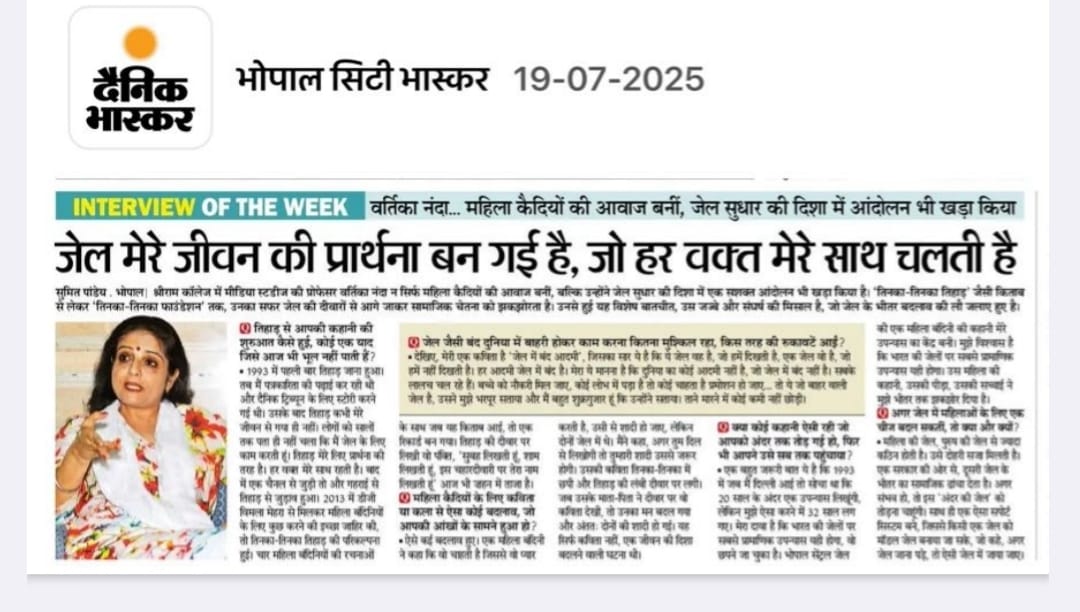
DAINIK BHASKAR: 19 JULY


AMAR UJALA: 22 JULY, 2025


TRANSCONTINENTAL TIMES: SPAIN: 23 JULY, 2025


Interview for Dainik Bhaskar was taken by Sumit Pandey.


Sumit Pandey is a pass out from Makhan Lal University, Bhopal. He proudly shared with me his picture where I was giving him an award in 2007 along with the VC, Dr. Achutya Nand Mishra.