Aug 18, 2020

Sources of News

DISCLAIMER: The Article provided below is a compilation of information from various sources. The references to the sources are provided at the end of the article. The views and/or facts expressed below are in no way related to the compiler. The blogger or the compiler shall not have any responsibility on the credibility of the information provided. This is an effort to help students during COVID-19.

A Report on SOURCES OF NEWS

By  Devunoori Vaishnavi 

INTRODUCTION 

News is happening all the time: People are being born or dying, banks are being robbed, roads are being planned, companies are making profits or losses, storms are destroying homes, courts are sending people to jail or freeing them, scientists are discovering new drugs. Every minute of every day something newsworthy is happening somewhere in the world.

Even if you are a journalist working in a small country, something newsworthy is probably happening in your country at this moment, while you are reading this book. Your job as a journalist is to get information on those events and present it to your readers or listeners. But you cannot be everywhere all the time to see those events for yourself. So you need other ways of getting information on all those hundreds (maybe millions) of events you cannot witness yourself. When someone or something provides you with information, we call them a source.

Sources of information can be people, letters, books, files, films, tapes - in fact, anything which journalists use to put news stories together. Sources are very important to report on events or issues and explain the world to the audience. Journalists try to work as much as possible from their own observations, but this is often not possible. Some events or issues are finished before the journalist gets there. Others are like plants which only show their stem and leaves above the ground - the all-important roots are hidden from sight. Journalists who only report what they see can miss much of the news unless they have sources to tell them of more details or other aspects which are out of sight.

TYPES OF SOURCES 

Journalists should deal in reliable facts. So, it is important that the sources  used for writing stories can give accurate information about what happened or what was said. But just as there are lots of different news events, so there are many different sources of information. Some of them will give very accurate information and we call these sources reliable (because we can rely on what they say). Others are less reliable, but still useful, while some can hardly be trusted at all. The main way of judging sources of information is on their reliability.

On the basis of providers, sources can be classified into

Primary Sources

Often the source is someone at the centre of the event or issue. We call such people primary sources. It might be a man who fell 1,000 metres from an aircraft and lived to tell the tale; or a union leader who is leading wage negotiations. They are usually the best sources of information about their part of what happened. They should be able to give accurate details and also supply strong comments.

The fall survivor might say: "I saw the ground rushing up towards me and I kept thinking `So this is death'." The union leader might warn: "If the employers want blood on their hands, we are ready to supply it."

Of course, just because a person was present at an event does not mean that they are either accurate or fair. The fall survivor may have injured his head after landing and so be confused. The union leader will want to present his side in the best light. It is vital to double-check and cross-check facts with other sources.

A word of warning here: If any of the sources, however reliable, gives the information which is defamatory, the concerned journalist can still be taken to court for using it. He/She is responsible for deciding whether or not to publish the defamatory material.

Secondary Sources 

Secondary sources are those people who do not make the news, but who pass it on. The official police report of an incident or comments by someone's press officer can be called secondary sources. Secondary sources are not usually as reliable as primary sources.

Most eyewitnesses should be treated as secondary sources for journalists because, although they are able to tell what they think they have seen, they are often not trained for such work and can be very inaccurate, without meaning to be. Journalists have to assess the reliability of secondary sources and if necessary tell  readers or listeners where the information came from. Secondary sources  include

1.     Press Release

A type of news source where information can be collected through the official statements made to journalists by the concerned organization, a political party or a government department. This type of news sources are tagged as “Pseudo Events”. They  attempt to make publicity.

2.   Press Conference 

It is a meeting at which somebody or the concerned organization talks to a group of journalists in order to answer their questions or necessary official statements. Here the concerned organization is prepared on the information they are disseminating to gain maximum publicity. for example, an interview .

3.   Speeches

Speeches are one of the important news sources today. The highlight of the speech is done on “who spoke” and ‘ what is spoken”. Majority of the political leaders, celebrities and famous people are given priority from the simple nonsense speech to the high level of speech.

4.   News Agency

News agency is an organization that collects news and supplies to newspapers, television and radio companies at a certain cost. News agencies collect news and sources  and sell them to other news organizations.

5.    Internet

The Internet has somehow challenged traditional news sources in many ways. It  is a storehouse of information. Reporters are finding it easy in collecting news sources  that they don’t need to run for news events instead information is right on their doorstep. Search engines such as google  and websites have countless information to provide.

Written Sources

Written reports can make an excellent source of information for a journalist. They are usually written after a lot of research by the authors, they have been checked for accuracy and are usually published with official approval.

However, just because information is printed, that does not mean that it is reliable. With typewriters, computers and modern technology, it is relatively easy to produce printed material. One must look at who has produced the document. Are they in a position to know enough about the topic and have access to the reliable facts? Do they have a reputation for reliability? This is especially important with information on the Internet. Anyone can put information onto the Internet. Unless the journalist knows how trustworthy they are, he/she cannot judge the reliability of what they write.

Leaked Document Sources

Documents are often leaked by people who believe that the public should know the contents (such as an environmental report), but who are unable to reveal it in public themselves, perhaps because they do not have the authority to do so. In some cases, documents are leaked by a person to gain an advantage over someone else, perhaps someone who is criticised in the report. Leaked documents are often excellent sources of news stories because they can contain information which someone wants to keep secret. This might be a plan to do something which the public might oppose, such as bulldozing homes to make a new road. It might be a report on corruption within an organisation which the heads of that organisation do not want to be publicly known.

There are also legal dangers to consider when using leaked documents. They might, for instance, have been stolen. It is usually an offence to receive stolen property if one thinks it could have been stolen, even if it is only a few sheets of paper. Photocopying the document then returning it is often a way to overcome this problem. Leaked documents could also be covered by copyright, so a journalist could be breaking the law by quoting directly from them. He/She is on safer ground in reporting the substance of what was said, in their own words.

Sources from Reporters

One of the most reliable sources of information (although not completely reliable) are other journalists. They may be  colleagues or reporters from a news agency which supplies one's organisation. If they are well trained, experienced and objective, their reports will usually be accurate and can be trusted. However, if there are any essential facts missing from their reports, these will have to be provided. Mistakes can happen. This is why news organisations should have a system for checking facts. A reporter's story should be checked by the news editor then the sub-editor. In small newsrooms, where the reporter may also be the editor or newsreader, the reporter must be especially careful in checking facts. There is also the danger that reporters misinterpret what they think they see and then present that as a fact. This often happens when reporting such things as the size of a crowd. Unable to count every person in it, they make an estimate, often sharing their guesses with other journalists on the scene. This is just an estimate and any report which says "there were 40,000 people present" should be treated with caution, unless the reporter knows the exact number who came through the gate. 

Tip-off Sources

Occasionally someone will call with a story tip-off but refuse to give their name. These are said to be anonymous (meaning "no name"). These are the most dangerous sources of information and should only be used with extreme caution. Although anonymous tip-offs can provide good story ideas, they must never be used without a lot of checking. If they are wrong, the concerned journalist will be held directly responsible unless he/she has checked what they said with other more reliable sources.

Often people who ring up with a tip-off will tell their name if asked, but on the promise that their name will not be revealed to anyone else. Journalists must still cross-check what they say because, of course, they cannot be quoted as a source if there is any dispute about accuracy. For example, if a journalist is taken to court for defamation.

 On the basis of storage and experience, sources can be classified into 

Stored sources

This refers to information a journalist can look up, in a book, in a library, on the Web – anywhere that information is recorded. The good news reporter knows sources of information and can find them quickly.

Once, this was considered the least useful of all types of sources for the journalist. The web has changed that, however. Now because of the web, stored information can be accessed quickly and readily, and that information is much more likely to be more recent. Even the web does not solve the basic problems of stored sources: they are static (they can’t be questioned) and they still may not contain the very latest information.

Observational Sources

This is information that a journalist can get from personal experience, by going to a city council meeting, a fire, a press conference, etc. Reporters like to be on the scene. They like to be at events. Covering news from an affair is not always satisfactory. They like to see with their own eyes, hear with their own ears. They like to talk to the people who are there and get the sights and sounds and smells of a news event. Being an eyewitness to something and being able to talk to people who have experienced it is an experience that cannot be duplicated. Reporters learn to prepare themselves to cover an event by

●  learning as much as they can about the event beforehand

●  getting into a position to see and hear what is going on

●  talking with people who are also experiencing the event

●  taking good notes; using a digital recorder; making notes to themselves immediately after the event

●  taking pictures

Personal sources

This is information that you get from talking to people. Most news reporters have to interview people to complete their news stories. Being able to talk to people — and getting people to talk to them — is one of the most important skills of reporters. Many people are reluctant to talk with reporters because they are afraid of being misquoted or afraid of the consequences of being in the news. Others are anxious to talk with reporters but they may not have good information or they may be pushing their own agenda or point of view. Reporters must learn to get the most from their sources by

● finding the right people to talk to (VERY IMPORTANT), rather than using “sources of convenience”

● respecting their feelings and position

● dealing with them ethically by identifying themselves, understanding the principles of on-the-record and off-the-record conversations, and maintaining the confidentiality of sources even when it is difficult to do so (such as being faced with going to jail)

● learning how to interview people properly

On the basis of occurrence, sources can be classified into

 Predictable News Source

Predictable News sources are sources that  are likely  to happen at a given time , date and location where the incidents take place. Such as  celebration, conference, festivals and parliamentary session etc.

 Unpredictable News Source

A type of news source where  incidents  occur all of a sudden and out of control. The reporters are unaware about the happening of these incidents. For example- landslides, earthquakes, shootings etc.

 Anticipated News Source

A type of news source where the information has to be investigated and  collected on the probability of making news. An example can be a reporter doing a beat report on crime.

 ATTRIBUTION 

When a journalist gets information from a source, he/she normally needs to attribute that information to someone. Attribution means to tell the readers or listeners the name and title of the person interviewed or the document from which the information is extracted. There are three levels of attribution, depending on whether the source is happy about being publicly identified or whether they want to maintain secrecy about what they tell. Based on attribution, sources can be classified into three types.

 On the Record

Most information given will be on the record. People will tell the details openly and allow the media to quote their names and titles. It is always best to get information on the record. On the record comments have an extra level of understanding for people because they know who is speaking and exactly what was said.

 Non-attributable

Sometimes a source will give information on the understanding that the information provided by them can be used but not attribute it to them. Source may do this for one of several reasons. Perhaps they are not officially allowed to give the information, but they think it could be made public. Perhaps they do not want to be in the public eye. Unattributed stories will not seem as accurate to the audience as stories where information is attributed.

 Off the record

Occasionally,  information will be given on the understanding that it is totally off the record. It usually means that both the information provided and the name of the source must not be disclosed. People usually give information off the record when they want the journalist to understand the background to something which is too sensitive for them to talk publicly about. 

 CONCLUSION 

Newswriting depends on information. The quality of the writing is tied to the quality of the information. The quality of the information depends on its source. All sources are said to be reliable if they can be believed consistently. If a source is always correct in the information they provide, it will be believed next time. If they make a mistake, one may doubt what they say. Reliability is built up over time. Thus, the reliability of all sources of information must be assessed to provide authentic content to the readers.

REFERENCES 

1. Tinka Tinka Dasna: Vartika Nanda: Tinka Tinka Foundation: 2020

2. Television aur Crime Reporting: Vartika Nanda: Rajkamal Prakashan: 2010

  https://www.thenewsmanual.net/Manuals%20Volume%203/volume3_59.htm

3     https://sonamchoekyi.wordpress.com/2016/01/13/sources-of-news/

4.   http://www.jprof.com/reporting/%E2%80%A2-sources-of-information/

5.    https://www.sociologygroup.com/news-sources-importance-in-journalism/
Jul 7, 2020

Department of Journalism: Farewell of Batch 2017- 20


The Department of Journalism, Lady Shri Ram College for Women, held a farewell for its senior-most batch with immense exuberance and excitement during the ‘pandemic’ times! The farewell is held as a tradition among all institutions so as to bid adieu to the passing out group and wish them luck in all their future endeavors. With a similar kind of enthusiasm and positivity, the 1st and 2nd year students took part in organizing a virtual farewell for their seniors on June 25, 2020. The function was an hour-long virtual meet. Unlike all the farewell functions, this farewell witnessed ‘internet’ hugs, ‘digital’ embraces, and ‘online’ joy. It was perhaps the most unique way to organize such an event in the recent years. However, the students worked hard to come up with ways that could still keep the seniors hooked to their screens!

The highlights of the event included allotment of titles, conduction of various games, and a nostalgic summary of their power-packed journeys! They were taken aback by the titles they were allotted and had a hard yet fun time guessing them. A number of games like ‘Never Have I ever’, or ‘Who is Most Likely To’ helped them all to quiz their friendships. The most fun surprise was revealed by the senior batch once they started unleashing all the inner divas! The farewell was a total success and turned out to be a mood-booster for all. Apart from these games, the seniors were asked to sum up their journeys in 3 words. While sharing their journeys, each of the students became nostalgic about their journeys during the last 3 years. The words that resonated with most were -empowerment, happiness, and growth.

The farewell function offered a way to all the students to enjoy, celebrate, and cherish their togetherness while keeping it safe through social distancing. The final years put in admirable effort with their beautiful and breath-taking attires that totally left the rest of the students flabbergasted! The act of dressing up was a way to mentally and emotionally connect to the celebration through their appearance and enjoy the farewell as they normally would have. While the network connections worked with some instability, the students blissfully realized the commencement of the life-long, stable and secure friendships that found roots in these magical walls of LSR. They seemed to have mixed feelings about the ‘online’ nature of the farewell due to the lockdown, however were grateful to be a part of this rendition due to the innovative efforts made by their juniors.  

The only worry they had was that of being separated from each other after being used to daily interaction for three years. They all shared their memories of their college days and were excited to move on to the next phase of their lives. There is uncertainty and excitement among all.  We wish all of them good luck for all their future chapters and bid them adieu with virtual blessings and love!

Soumyaa Rawat
920, 1 st year
Dept. of Journalism
Lady Shri Ram College for Women

Jun 30, 2020

तिनका जेल न्यूज ने कोरोना जेल समाचारों का रिकॉर्ड बनाया

तिनका जेल न्यूज ने कोरोना जेल समाचारों का रिकॉर्ड बनाया

COVID-19 के दौरान जेलों की पहल के लिए समर्पित एक विशेष YouTube चैनल

  • पिछले 51 दिनों में 51 कहानियां जेलों का एक नया चेहरा सामने लाती रहीं
  • यह खंड 2018 में शुरू किए गए तिनका तिनका जेल सुधार चैनल का एक हिस्सा है
  • चैनल बाहरी दुनिया की मदद करने के लिए कैदियों और जेल कर्मचारियों के योगदान पर केंद्रित है और एक नई तरह की पत्रकारिता की अलख जगा रहा है
  • जेल सुधारक वर्तिका नन्दा तिनका तिनका फाउंडेशन की संस्थापक हैं, जिसका मकसद भारत भर की जेलों को जोड़ना है।

तिनका तिनका जेल समाचार के बारे में


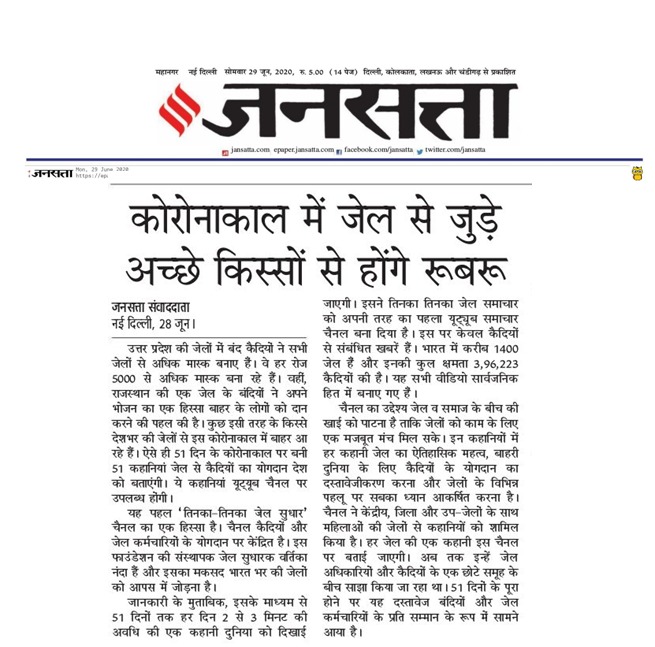
51 दिनों तक हर दिन एक से तीन मिनट की अवधि की कहानी कोरोना के दौरान जेलों और उनके योगदान की दुनिया को सामने लाती रही। इसने तिनका तिनका जेल समाचार को अपनी तरह का पहला YouTube समाचार चैनल (tinkatinkaprisonreforms) बना दिया है जिसने भारत भर की जेलों से समाचार पहुंचाने के लिए खुद को समर्पित किया है। भारत में करीब 1400 जेलें हैं, जिनकी कुल क्षमता 3,96,223 कैदियों की है। तिनका तिनका जेल समाचार एक समय में एक जेल या एक मकसद पर तथ्यात्मक कहानी सुनाता है। इस पहल की शुरुआत मार्च में लॉक़डाउन की शुरुआत के साथ की गई थी। मई से इसे एक नियमित अभ्यास बना दिया गया। यह सभी वीडियो सार्वजनिक हित में बनाए गए हैं।

तिनका तिनका जेल न्यूज़ जेल सुधारक वर्तिका नन्दा की संकल्पना है। इसका उद्देश्य COVID-19 की वजह से लगाए गए लॉकडाउन के समय जेलों और समाज के बीच की खाई को पाटना है और जेलों के काम को एक मजबूत मंच मुहैया करवाना है। इस पहल की भावना तीन भागों में है- हर स्टोरी में जेल विशेष के ऐतिहासिक महत्व को प्रकट करना, बाहरी दुनिया के लिए कैदियों द्वारा किए गए योगदान का दस्तावेजीकरण करना और जेलों का एक पहलू प्रस्तुत करना जोजिस पर किसी का ध्यान नहीं जाता। एक समय में एक कहानी सुनाकर, इस चैनल ने भारत में जेलों के कम ज्ञात चेहरे को बाहर लाने के लिए खुद को समर्पित किया, खासकर COVID-19 के दौरान। दिलचस्प बात यह है कि चैनल ने सभी महत्वपूर्ण प्रकार की जेलों-केंद्रीय, जिला जेलों , उप-जेलों और महिलाओं की जेलों से कहानियों को उठाया है। चैनल दुनिया में मदद करने के लिए मास्क, सैनिटाइज़र, पीपीई किट और अन्य साधनों के छोटे पैमाने पर प्रयासों में लगे कैदियों के वास्तविक योगदान को जोड़ने में सक्षम रहा है। इन कहानियों में संबंधित अधीक्षक और अन्य वरिष्ठ कर्मियों के नाम उल्लिखित हैं।

चैनल ने इस योगदान के एक विशाल रेंज दिखाया है। जिला जेल, मेरठ, उत्तर प्रदेश में बंद कैदियों ने उत्तर प्रदेश की सभी जेलों में अधिकतम मास्क बनाए हैं। वे हर रोज 5000 से अधिक मास्क की सिलाई करते हैं। राजस्थान की एक जेल के बंदियों ने अपने भोजन का एक हिस्सा बाहर के लोगों को दान करने की पहल की। मध्य प्रदेश की केंद्रीय जेल, जबलपुर में 40 पुरुष और 13 महिला बंदी हर दिन 1500 मास्क बनाने में शामिल हैं। मध्यप्रदेश में लगभग 52 जेलों में यही किया जा रहा है। मॉडल जेल, चंडीगढ़ के बंदियों ने अपनी गाढ़ी कमाई में से 1,11,000/ रूपए कोरोना के संकट से बचाव के लिए मुख्यमंत्री राहत कोष को दान में दिए। तिनका तिनका के प्रयासों से पिछले 51 दिनों में जेलों के बदलाव और काम की सच्ची कहानियाँ दृढ़ता से उभरी हैं। इस श्रृंखला में बंदियों के काम के अलावा रविवार को योग दिवस और विश्व संगीत दिवस जैसे कुछ विशेष दिन और तिनका और बंदियों के कुछ साझे प्रयास भी सरोकार के तौर पर शामिल किए गए। इऩ्हें जेल अधिकारियों और कैदियों के एक छोटे समूह के बीच चुपचाप साझा किया जा रहा था और उन्हें सार्वजनिक चकाचौंध से दूर रखा गया था। 51 दिनों के पूरा होने पर यह दस्तावेज बंदियों और जेल कर्मचारियों के प्रति सम्मान के रूप में सामने आया है। इन समाचारों का संपादन रिया वर्मा ने किया है और मोंटाज को नितिन चौधऱी ने बनाया है। अब यह चैनल जेलों पर साप्ताहिक प्रस्तुतिकरण करेगा।


वर्तिका नन्दा के बारे में: वर्तिका नन्दा जेल सुधारक हैं और तिनका तिनका भारतीय जेलों पर उनकी श्रृंखला है। वे 2014 में भारत के राष्ट्रपति से स्त्री शक्ति पुरस्कार से सम्मानित हो चुकी हैं। जेलों पर उनके काम को दो बार लिम्का बुक ऑफ रिकॉर्ड्स में भी जगह मिली है। वर्तमान में वे दिल्ली विश्वविद्यालय के लेडी श्रीराम कॉलेज के पत्रकारिता विभाग की प्रमुख हैं। संपर्क : tinkatinkaorg@gmail.com / 9811201839

Jun 23, 2020

Post Pandemic Education: Blogs As An Interactive Medium

Presenting to you a detailed article on the philosophy behind this blog. Starting in 2006 as a platform of sharing of views on journalism, it made a gradual shift to become a virtual classroom. This practice has been specially handy during the ongoing COVID-19 epidemic. Simran Rawat presents to you a comprehensive report.  Editor.

By Simran Rawat


Dr. Vartika Nanda, Head of Department-Journalism at Lady Shri Ram College has come up with an innovative way to teach and talk to students during the digital learning era. She is using her blog http://vartikananda.blogspot.com/  to disseminate important information to her students as well as bridge the gap between virtual and classroom teaching. It has become a one stop shop for students to access all their reading material and clarify their doubts. In the absence of a central mechanism for this in Delhi University, Dr. Nanda’s blog is a pioneering step in the direction of collating online educational resources. Other than written pieces and books, there are also many useful video links embedded in the content alongside links to further reading material. The section about books related to media is a handy resource for students to get an overview of important texts. Containing blogs from 2006 to 2020, the site also acts as a useful archive of information that students can continue to refer to.

Students are the consumers and also producers of content at several places. A number of articles written by them on the topics related to journalism, are being incorporated on the blog on a regular basis. Once each article is published, the entire class contributes to improvise and improve it. In this manner, by the next day, an entirely new and supplemented document is ready. Having their work shared on the site, with by-lines gives students a feeling of pride and is a meaningful addition to their portfolio. The purpose of this enterprise is both education and documenting some of the crucial contributions made by the students. Each student’s level of involvement is based on their own enthusiasm and certain students have shown great gumption in making the most of this opportunity. Anushree Mukherjee, Himani Jindal and Riya Verma from the first year and Aastha Poddar and Shraddha Acharya from the final year have made special contribution in adding content to the blog. This blog is a classroom dedicated to the students of Journalism. For instance, Lockdown Diaries is a unique engagement exercise wherein students have written about their COVID quarantine experiences. It has given them a cathartic tool as well as a means of creative expression and a way to connect with their peers by means of shared experience. Students engage with the content through comments, wherein many have added more points and resources to the discussion.


Many students have also written personal articles about their journey in college, and enjoy the feeling of returning to the site to reminisce about days past. It helps document significant achievements and elaborates on the many discussions and events that have occurred on campus; serving as a useful compendium of the Journalism department’s endeavours for anyone to view at a glance. The site further highlights innovative pedagogy used by Dr. Nanda to immerse her students more fully in the practice of journalism. The techniques used are one of a kind and serve as an example for how journalism teaching must incorporate practical components to be effective. A few examples of this are efforts by the students to design a magazine and newspaper from scratch. Students are responsible for thinking of names for their publications, finding articles, finalizing layouts, placing appropriate articles under the correct headings and more. Through activities like these, students develop critical and creative thinking and experience journalism in a hands on manner and not just as a theoretical subject.


The site is a veritable treasure trove of information about Dr. Nanda’s significant efforts for prison reforms, through the Tinka Tinka movement she founded few years ago. The blog helps one retrieve many useful facts and glean knowledge about the same. This section include relevant documents on Tinka Tinka Tihar, Tinka Tinka Dasna and Tinka Tinka Madhya Pradesh- three unique milestones in the arena of prison reforms in India. Other sections include columns on journalism, Dr. Nanda’s poetry and a media glossary. Dr. Nanda’s Media Desk provides a quick and comprehensive view of her extensive work in media and her different publications. The newly introduced Corona diary about prisons is a unique initiative to document the life of prisoners during the pandemic.


Overall, this blog serves its purpose as an amalgamation of information and resources as well as a platform for students to express themselves and partake in discourse. It is an opportunity for young journalism enthusiasts to see their work preserved for posterity and to make their engagement with the course more meaningful. Educators can pay heed to this distinctive approach and utilise this method to make teaching and interaction easier for both teachers and students.

#journalism #lsr #tinkatinka #covid #vartikananda #ladyshriramcollege

Media and Prisons:Makhan Lal Chaturvedi University: Bhopal

#MCU #स्त्री_शक्ति_संवाद #online_discourse

https://www.facebook.com/watch/live/?v=1123284448034820&ref=watch_permalink


'We should see the bad where there is needed to notice it. We should see the positive things. If we continue to see the bad, we will not be able to do good.' Media professor Dr Vartika Nanda said this in online lecture series 'Stree Shakti Samvad' today, organised by Makhanlal Chaturvedi National University of Journalism and Communication, Bhopal.

Dr Nanda, who is famous for her work on welfare of prisoners, has been a crime reporter in electronic media.

On her lecture on 'Jail and Media', she shared her experience of launching Tinka Tinka, a movement for jail prisoners. She said she gave up her approach what she continued to follow in media and had dialogue with prisoners without any prejudice. Life in jails is difficult and full of pressure. There are many in jails who have not committed any crime. There are many other prisoners who have committed crimes and they regret. She had sympathy with all such prisoners. But, in the jails and outside, there are many people who have committed crimes but do not regret. We should not have sympathy with them.

Dr Nanda said corona made us felt the jail life and we should not forget it. She said whoever need justice, must be helped. But we should not publicise it. Many prisoners want to share their creativity with the outside people. Some women prisoners drew pictures and penned poems.
Sharing her experiences, Dr Nanda said the life taught her that we should speak less and should be seen less if we want to take a big task. She suggested that one more 'H' - humanity, should be added with five W and one H - what we are taught in basics of journalism. As a journalist, one should maintain secrecy and follow commitments. Home work should be done before taking interview.


Jun 18, 2020

Tracing down the Truths

In the dreadful and daunting times of the lockdown due to the ongoing COVID-19 pandemic, the world is currently binging on the feelings of negativity and fear. In a world where a thousand deaths are registered every day and millions of active cases being reported every hour, mankind is witnessing one of its kind situations where normalcy has been hit hard and hope is the only sigh of relief. In such times of sickness and self-isolation, the global population has been locked down within their houses and roads are the new ‘NO ENTRY’ zone. For all age groups, the virus is highly dangerous with some portion of the fatality increasing among children and senior citizens. While the whole world is trying to keep up with the completely novel arena, the student community has been dented in some ways that are unattended to or simply avoided at the present moment. Out of all age groups, the students are the ones who, in such mentally disturbing and physically challenging times, have to keep up with their studies, their ambitions, and their daily targets to be achieved in order to not let any of the precious moment be wasted. The workforce population across the world has been another age group finding it difficult to keep up with the scarcely available jobs and most of all, be able to bear all the household expenses.

The student community coexists in both age groups, maintaining grades on one hand, and striving to earn a living by looking out for internships and part-time jobs. Yet with such uncertainty of time and future, the world cannot be a sugar-coated place for every student. Moreover, the role of the students in the situation of the pandemic is quite challenging and noteworthy.

First of all, the student community is an active, alert, and adaptive community. This reflects on the way the students conduct themselves and perceive the current affairs or the world events going on around them. The current status of negativity and rising death tolls is being conjectured by the teenagers as a disturbing future that might haunt their lifestyles for the years to come. In a free and independent environment where such individuals are used to setting their souls free in the open air and under the blue sky, the world is forcing them indoors.

The students around the globe are being strictly asked or ‘pressurized’ to not let any of the mentally draining or disturbing situations affect their studies. While this is being presented by their parents and teachers, the schools are simultaneously putting in efforts to educate them virtually that might not be possible for every single student or result in effective education, given the economic and social disparity present in the society. In addition to this, there are students who had appeared for state-level or central board examinations that might be stressful for another straight 5-6 months before they reap what they had grown! Another lot of these students are the ones who will be appearing for such exams, and will thus be required to keep up with the pressure, anxiety, hard work, and most of all positive energy.

Another remarkable role for the student community to embark upon is that of extending a helping hand at their houses and helping their parents and family members to finish off the household chores. Having said this, the students are the most highly targeted group for not performing household chores and defamed for being lethargic and adapting a laid back attitude. Perhaps the students become kids at home who have to be highly responsible and responsive to the help being asked for, without having any playtime breaks or chitchat sessions with friends living nearby. It is an unfair phenomenon for teenagers and kids to be locked down in their own homes and struggle with daily schedules.

A fourth of all challenges refer to being able to live in homes that reflect disturbed relationships, or broken family bonds. This means that a major stratum of the society consist of homes that might be dealing with broken marriages, domestic violence, child abuse, sexual assaults, mental breakdown, unhealthy lifestyles of either of the parents or simply degraded atmosphere of peace where a student cannot flourish at his/her best and is thus left to deal with problems beyond his/her control.  The coming together of all this can lead to a disturbed lifestyle, unhealthy mental state, negative ambiance to progress, or an individual that is likely to face major problems in the coming future.

The topic of distraction is being actively and loudly addressed with all neighbors, relatives, siblings, parents, friends, etc. warning the students to maintain a routine lifestyle and not indulge in any of the distractive exercises. This refers to remaining active on social media for long durations, binging on web media platforms till late nights, playing online games and consoles for large spans of time, and chatting with friends all day long. All of this can be practiced in moderation and considered to be healthy and mind-relaxing. However, an excess of such activities can lead to conflicts and disturbed concentration levels. Apart from these ordeals, the conflict of not being able to release their stress by playing, working out, exercising, or walking can affect their mental well-being. 

The ongoing crisis of contentment and happiness within these individuals is even more challenging. With uncertainty on its peak and the escalation of disheartening events occurring all over the world, the student community is the only community that is struggling to visualize the distant future with hazy eyes and blurred mindset. They are uncertain of their health, happiness, and healing of the world. The future will be owned by them, governed by them, and built by them, but does the present pandemic really set an example for them to look forward to the golden years to come or just accept the brutal truth that the world has deteriorated in its own eyes and that they have the burden of negating such evils of society. As young adults, they have the power and passion, yet they are missing out on perception.
Perception for a better, happier, and a brighter future!

Name- Soumyaa Rawat
Roll No.-920
Batch- 2019-22

Jun 16, 2020

The PGlogs: Conversations that Inspire


The world that was already healing from  natural calamities, mass casualties, and several other catastrophic events slammed upon it earlier, was recently hit by an unprecedented storm. The coronavirus is a menace in true sense, that has taken a heavy toll on millions of human lives.

The pandemic has kept us all under a lockdown leaving us confined within our homes, ironically with plenty of things to do. This period of homebound allowed me to turn the searchlight inwards and grow in so many ways. Among so many things I laid my hands on in order to manage well this predicament, I also created a YouTube channel of my own.

I started the ‘The PGlogs’ with the purpose of bringing forth the issues that have been sidelined for years now and conversing with personalities who against all odds established themselves and continue to inspire the world.

First, I interviewed High Priestess Laxmi Narayan Tripathi, who is a transgender rights activist and the first ever transgender to have represented Asia Pacific at the United Nations in 2008. She was also one of the petitioners in the landmark ruling by the Supreme Court of India announcing the abrogation of Section 377. She talked about the struggles she had to go through all her life as transgender, and how she rose above all of them and went on to conquer the world. She inspires all of us to respect our identities and love ourselves.

Then, I did a Skype conversation with renowned Bollywood Actress, Former Miss India and Fourth runner-up at the Miss Universe, 2001 and the current United Nations “Free & Equal” Campaign Ambassador, Celina Jaitly. She talked about several impediments she encountered and how she moved past them, also defeating depression and making an entry back again into the World of Cinema.

Both of them have galvanised many into raising their voices for worthy causes and inspire us to do so for as long as we can. They are an epitome of the fact ‘Women can be and do anything!!’

All along these interviews that I have conducted, I have applied the pre and post interview techniques focusing on the questioning approach as well as the analysis of information obtained, explained by our Head of the Department, Dr. Vartika Nanda Ma’am as a part of the paper ‘Reporting and Editing for Print’ offered to us, who has been guiding us both theoretically and practically by giving us different kinds of assignments. I thank her for her constant guidance and feedbacks.

With this platform, I hope to direct myself  to the ocean of knowledge and continue to bring forward #ConversationsThatInspire.


Submitted By: Palomi Gupta
B.A. (Hons.) Journalism
Batch of 2022
Lady Shri Ram College For Women

Jun 6, 2020

LOCKDOWN DIARIES

The students of the Department of Journalism, Lady Shri Ram College for Women, participated in the collective exercise of writing an account on the theme - ‘Utilising my Time to the Fullest During the Lockdown’. This activity strived to increase the creative engagement of students by creating a shared space where they could digitally exchange their experiences. These stories are compiled by Himani Jindal and Anushree Mukherjee.


Mr Quarantine arrived in our lives without any invitation and is teaching us important lessons. I initially complained about being within the confines of my home… but eventually I found solutions for the problems I faced. I completed two virtual internships - in content writing and human resources management - which improved my time management skills and boosted my self-confidence. I have enhanced my skill as a researcher with the assignments given by my professor on various topics including the role of a sub-editor and cartoons in print media.
Somewhere in this journey, I learnt to balance procrastination and stress. The best part of being at home is that I got a lot of quality time to spend with my family. All I can recapitulate is: “Life is balancing between what you hate in your life and what you can’t live without”.

Surbhi Gupta
Department of Journalism
Batch of 2022

I cannot recall the last time I had this much free time without homework. I began keeping a log of the books I read recreationally on Goodreads, which is something I used to do in school but could not keep up with at university.
The most recent one I read was 'Normal People’ by Sally Rooney - set in Ireland, it follows two people who come from very different socio-economic backgrounds and form a friendship as they enter University and their worlds change with time. Additionally, I started learning Norwegian on Duo-lingo, which is an app that combines language-learning with fun quizzes. As for what else I want to do - I might try my hand at coding, it has never worked out well for me but I'm curious to begin again.

Mamta Kumari (CIC)

During this lockdown period, I’ve tried to keep myself busy and explore different things. I took up the activities that I left some time back to kill boredom and simultaneously be productive.
I took part in some online conferences and debate competitions. I wrote an article for a Journal and some pieces for the college societies’ magazines. I completed an online workshop on Journalism.
I’ve started exercising and meditating daily. I love watching TED talk videos which help me in keeping my optimism alive. I also try cooking on certain days as I enjoy doing so.

Sonal Agarwal
Department of Journalism
Batch of 2022

The first of its kind, the COVID-19 global pandemic has brought forth the wrath of the coronavirus and the consequences of its widespread. The global village has been locked down within its own overseas doorways.
Yet this lockdown has put forward the opportunity for all to break-free the monotonous lives. With the lockdown being observed all over the world, I have involved myself in some household chores and experimenting with different things. I have been in constant search for knowledge and learning. Yet, I never fail to play with my dogs. As I have been blessed with a privileged socio-economic space, I have tried my best to use it by constantly looking out for my fellow citizens who are deprived of basic essentials. Lastly, I have been observing the healing of our environment. After all, it is the goodness that will pull us out of the hardships.

Soumyaa Rawat
920
Department of Journalism
2022


I took this period of lockdown as an opportunity instead of taking it as a challenge. During these days, I got a chance to closely observe and enjoy nature. I started learning how to bake. I worked over my reading and writing skills. I joined hands with an NGO to help those who were in need and have been hit hardest due to the sudden outbreak of COVID-19. A small part of me is thankful for the time I got to spend with my family. Sitting in the living room watching epic stories - Ramayana and Mahabharata, and listening to my parent’s childhood stories have become special memories. These were some beautiful moments that I managed to experience amidst the ongoing miserable situation of our world...

Somya Jain
298
Department of Journalism
Batch of 2022

The lockdown has been a mixed experience for me. I started to do everything I couldn’t find time for before. The most productive part of my day is working out and cooking my post workout meal. Earlier, I didn’t even enter the kitchen but now I can cook for myself. I spent my quarantine days rewatching all my favourite movies and focusing on personal growth. On days when I am anxious because of the whole situation, I calm myself by practicing meditation. Lockdown has taught me that our life, mind, heart and soul is like water. When it’s turbulent, it’s difficult to see. When it’s calm everything becomes clear.
-Harshita Solanki
Department of Journalism
Batch of 2022

Being in Delhi as an outstation student, I really missed all those days where I've been with my family. So this lockdown brought us together. Being in my home and spending whole day with them never bored me. And the best part is that I learned cooking during this period. Also I've started doing yoga regularly. I read four novels which earlier took me even months to read a single novel. With many people struggling across the world, I'm grateful for the life I have and that it helped me better myself.
 Parvathy R
Department of Journalism
Batch of 2022


 The lockdown made me realise the interconnectedness of everything around me and allowed me to turn the searchlight inwards.
 I interned with the a Magazine based in New York, United States in the month of April. From the very first day of my internship, I learnt several work values, especially discipline, and worked on bettering my writing skills each day.
Due to my constant pursuit of growth, they have designated me the position of ‘Opinion Columnist.’
 I also started a blogging and vlogging website of my own and YouTube Channel alongside, where I aim to get on-board people who are an inspiration to the youth of the country for an interview, the first of which is going to happen with transgender rights activist Laxmi Narayan Tripathi.
 Palomi Gupta
Department of Journalism, LSR
Batch of 2022

During the lockdown I having been spending my time doing a lot of things and activities I used to enjoy immensely in the past. As a child I was extremely fond of gardening so I have been spending a lot of time in my garden and I have turned into an avid Gardener. I have been looking after the plants and trees in my garden and have also planted a variety of new plants which includes difficult kinds of flowers and vegetables. Besides gardening I have also been keeping myself very busy by reading a lot of E-books and even writing. I have been taking online workshops and classes on the topics and areas of interest.During this lockdown I have made a genuine effort to reconnect with all my friends from school with whom I had not been in touch. Altogether, I have been trying to learn new things and skills during this lockdown but I have also been doing the little things that bring joy and happiness to me like playing online games.
                     
- Shivangi Chopra
 Department of Journalism
  Batch 2022


Lockdown of a whole country can be especially be stressing, and it can affect our mental, physical and emotional health. I consider myself a sedentary person, but after two weeks of being locked in my home I found myself having several nervous breakdowns.
In order to keep myself occupied, I enlisted myself to various things. I stated taking online courses on photography and various free Harvard University courses. I took some time and started baking and helping my mother in maintaining our rooftop garden. I have ample time researching for internships and Graduate scholarships.
I am thankful for a home, for my friends and my parents at this testing time and I hope things get back to normal as soon as possible.

Agrima Gulati
Journalism department
Batch of 2022


Jun 5, 2020

अपराध, जेल और सच । World Environment Day | Sahitya Aaj Tak

कोरोना और जेल डायरी | | | सरोकार: केरल की हथिनी के नाम 

इंसान पर यकीन की कीमत उसकी अपनी जान थी

और उसकी भी जो इंसानों से अनजान थी

आप कहते हैं अपराधी की जगह जेल होती है

लेकिन कई बार खुद जेल भी शर्मसार होती है

जेल की अपनी सीमा है/ अपराध की भी कोई सरहद होती होगी

जेल की सींखचें इन हदों के पार होने पर कसमकसाती हैं

दुखों को सोखने की बर्दाश्त अब पार हो गई है

आप जेल को जेल ही रहने दें

ऐसे अपराधों के लिए किसी नई सजा को खोजिए, कुछ नई धाराएं

क्योंकि इन अपराधियों ने कहां पहली बार अपराध किया होगा

किस्तों में हो रहे अपराध छोटी-छोटी परछाईं बने होंगे

और फिर मन का शैतान बड़ा हुआ होगा

कोरोना और काल जिन्हें सबक न दे सका हो

जेलें भी उन्हें क्या समझा सकेंगी, क्या सुधार सकेंगी

जेलें हार गईं हैं

इंतजार कीजिए। अपमान और धोखा लौट कर जरूर आता है


जहां, कानून, नियम और जेलें अशक्त होती हैं

वहां एक शक्ति होती है जो सबसे सशक्त होती है।

-         वर्तिका नन्दा


Manu Sharma, Jessica Lal Case and the Days of Television Reporting

साल 1999। मनु शर्मा मामले की रिपोर्टिंग। एनडीटीवी में अपराध बीट के प्रमुख से लेकर अपराध पर पीएचडी, टीवी और अपराध पर किताबें और अब जेल के तिनके। अपराध को समझने में करीब 24 साल का सफर!

हौजखास थाने से लेकर पुलिस हेडक्वार्टर और बाद में कोर्ट की तक- मनु की रिपोर्टिंग का वह साल सीख से भरपूर था। मुझे याद है जब मनु को थाने में लाया गया था। हम सभी घंटों थाने में खड़े रहे। देर शाम तौलिए से उसे मुंह को ढक कर जब गाड़ी थाने पहुंची थी तो खबरों की आपाधापी का आलम अलग था। खबरों के चेहरे कैसे बदलते गए थे। तब रिपोर्टिंग का रोमांच, चुनौती और उसका प्रभाव अलग था।

मनु शर्मा जैसे कई मामले बार-बार यह याद दिलाते हैं कि सभी अपराध एकाएक नहीं होते। अचानक होने वाले अपराधों की तुलना में उन अपराधों की चर्चा कम होती है जिन्हें अपराधी धीरे-धीरे अपने अंदर पालता है। जिन परिवारों में आपराधिक प्रवृत्ति के बच्चे होते हैं, परिवारों को उनका पूरा इल्म होता है लेकिन वे उसे ढकते हैं या नजरंदाज करते हैं। आने वाले समय में बड़े अपराध को करने वाला शख्स बार-बार अपराध करने की अपनी प्रव़त्ति को जाहिर करता है। यकीन न हो, तो अपने आस-पास देखिए। सोचिए।

वह ऐतिहासिक था। इलेक्ट्रॉनिक मीडिया में पहली बार तब किसी महिला पत्रकार को एक बड़े चैनल नें अपराध बीट का प्रमुख बनाया था। फिर अपराध के कितने ही नए रंगों को समझती गई। आज जब इस पोस्ट को लिख रही हूं, तो भी अपराध की एक नई परिभाषा के काम पर जुटी हूं। अपराध और अपराधी को समझने की कोशिश में जिंदगी की समझ बहुत बदली है।
अपराध और अपरधियों पर बात- किसी और दिन। तिनके वो बात लिख रहे हैं।
सोच रही हूं कि जेसिका लाल का परिवार आज क्या सोच रहा होगा।।।

लंबी कहानी है।।।