Promo of Episode 66:
Watch on YouTube: https://youtu.be/JADy4bhrM10
Sixty-Sixth Episode of Kissa Khaki Ka: Released on 16 April 2023:
Watch on YouTube: https://www.youtube.com/watch?v=LQUqDEiDfls
Promo of Episode 66:
17 April: 2023
This is the 17th year of VN Ki Paathshala, a pioneer in the field of journalism and media education. Created as a medium to blend traditional and modern learning, it has been a satisfying journey. From media education, academic work in LSR and stories of change from Tinka Tinka Foundation, this platform is a mix of citizen journalism and participatory journalism. Today, we will be announcing our next chapter of VN Ki Paathshala. I am grateful to my students. Gratitude also goes to the prison population that has made me learn and grow as a better human being.


.jpeg)
DISCLAIMER: The notes given below are the compilation of information from various sources based on the topics that were discussed in the ‘Media Laws and Ethics” class. These notes are being compiled to help the students of Journalism enhance their knowledge.
DEPARTMENT: B.A. (Hons) Journalism
SEMESTER: III
PAPER: Media Laws and Ethics
TOPIC: Coverage of Child Abuse in the Media
INTRODUCTION
The media have played a major role in defining what is "normal" and what is "deviant" in society, thus contributing to definitions of what is and is not considered child abuse. The media have been essential to the growth of society’s awareness of child abuse and neglect, not so much from specific community education campaigns as through ongoing news and features reporting on specific cases, research, and intervention initiatives (Gough 1996).
The failures of child protection services in particular have preoccupied the media in Australia for decades (Stanley and Goddard, in press) with headlines having a familiar ring wherever they appear: in the following, United States: “Brianna report cites chaos in 7 DC agencies" (Horwitz and Higham 2000) New Zealand: "Never again: how we failed James Whakaruru" (Collins 2000); United Kingdom: after the terrible death of Victoria (known as Anna) Climbie, "Why did no one try to save this bright, happy girl?" (Bright and McVeigh 2001).
Other child abuse stories feature prominently and regularly in most major newspapers. The Courier Mail in Queensland carried a major story entitled "Drinking dad drops his baby, court told"
HISTORY
In 1962, Dr. Henry Kempe and his colleagues published their article "The Battered-Child Syndrome" in the Journal of the American Medical Association (Kempe et al. 1962). According to Barbara Nelson (1984: 58), this "caused a storm" in the medical and mass media, with the AMA contributing a press release entitled "Parental abuse looms in childhood deaths". Nelson argues that while the "rediscovery" of child abuse as a social issue is usually attributed to the work of Kempe and his colleagues, "in point of fact, the popular articles based on Kempe’s research were equally important in creating the sense of an urgent national problem" At this stage child abuse was defined narrowly, and speedy legislative responses were therefore possible. The media’s role was important "in transforming the once-minor charity concern called ‘cruelty to children’ into an important social welfare issue.”
CHILD ABUSE MEDIA REPORTING IN INDIA
The total crime against children rate went up from 28.9 percent in 2020 to 33.6 percent in 2021. Crimes against children across India increased by 16.2 percent between 2020 and 2021. In a global compilation of reports of child sexual abuse material (CSAM) found online, India stands right on top of the list, with 11.7% of the total reports or 19.87 lakh reports, followed by Pakistan, which contributes 6.8% of all reports (11.5 lakh reports).
Case study: to check the quality of Indian media reporting of child sexual abuse in India. Background: Media plays an important role in creating awareness and shaping public opinion about child sexual abuse (CSA). Research suggests that sensible media reportage on CSA is important for the positive impacts of media. However, most of the studies assessing the quality of CSA news reports are from Western countries.
Aim: To systematically assess the pattern of online news media reportage of CSA in India.
Methodology: A total of 149 news reports on the topic of CSA in India, published online over one year were analyzed. Framing of CSA and other news media characteristics were evaluated.
Results: Framing of CSA was episodic in the majority of news reports, with criminal-justice system-related details about individual cases mentioned in about 90% of reports. Further, more than two-thirds of news reports did not mention possible causes or reasons for CSA, and possible steps that people could take to prevent CSA. About one-fifth of news reports provided statistics, research findings, or correct information to dispel myths or wrong public stereotypes about CSA. The inclusion of a child helpline or contact information for any child welfare/support services was missing in most of the news reports.
Conclusion: This is the first study to systematically assess the quality of news media reports on CSA in India. It provides valuable baseline information about existing media practices and helps in identifying areas for further improvement of media reporting on CSA. There is a need to conduct regular workshops with media professionals to provide them with adequate training and support for improving the media reporting of CSA. While acknowledging that the media’s portrayal of child abuse and child protection can have negative consequences for children and their families, it is argued that media coverage is vital if public concern for children is to remain on the political agenda, and if child protection services are to remain accountable.
LAWS AGAINST CHILD ABUSE IN INDIA AND ACTIONS TAKEN BY THE GOVERNMENT
Child abuse is a pervasive and disturbing problem in India, with millions of children being subjected to physical, emotional, and sexual abuse every year. Between the years 2017-2020, there were 24 Lakhs Cases of child abuse were reported, out of which 80% of the victims were girls below the age of 14.
The Government of India has implemented several legal measures to protect children from abuse, and these measures are aimed at preventing, detecting, and punishing perpetrators of child abuse.
Despite the high numbers of reported cases, many cases of child abuse go unreported, and the true extent of the problem is likely to be even greater. The effects of child abuse can be devastating, leading to long-term physical and mental health problems, as well as social and economic consequences.
Historically, we have witnessed constructive changes in laws, policies, and recognition of human rights and child rights. The Constitution of India guarantees children’s rights.
Child Protection Laws in India are framed in line with constitutional provisions for safeguarding child rights. More than 250 statutes in India have been passed by the Union and State Governments. Some of the important legislations and their important provisions are as follows:
Indian Penal Code, 1860 (IPC)
Criminal Procedure Code, 1973 (CrPC)
The Criminal Law (Amendment) Act, 2013, the punishment for the rape of a minor girl has been aggravated (made more serious) under section 376(2)(i) of IPC. The punishment for rape of females below 16 years of age shall be minimum rigorous imprisonment of ten years which can extend up to life imprisonment.
The list of the child protection laws passed by the Union Government includes the following:
Children Pledging of Labour Act, 1933 (CPLA)
CPLA prohibits the pledging of the labor of children by the parent and any other person who employs children who have been pledged for labor. [5]
Child Labour (Prohibition and Regulation) Act, 1986 (CLA)
Child Labour (Prohibition and Regulation) Act of 1986 [6] is a law for the protection of children from child labor in India. The act prohibits the employment of children in hazardous occupations and also sets the minimum age for employment in any kind of work.
The Immoral Traffic (Prevention) Act, 1987 (ITPA)
The act makes it illegal to procure, transport, or hire a person for sexual exploitation or prostitution. This act also makes it illegal to traffic children for any purpose, regardless of their gender.
Prohibition of Child Marriage Act, 2006 (POCMA):
POCMA follows the basic premise
1. to make a child go through marriage is an offense, and
2. child or minor is a person up to 18 years of age in the case of girls and 21 years in the case of boys.
Right of Children to Free and Compulsory Education Act, 2009
The State was mandated to provide free and compulsory education within ten years under the Right to education. It was earlier a Directive Principle of the State but now, the Right to Education is acknowledged under the fundamental rights, making it a justiciable right under Article 21A. The Right to Education Act, 2009, also known as RTE Act describes modalities of the importance of free and compulsory education for children aged between 6-14 years in India.
The Protection of Children from Sexual Offences Act, 2012 (POCSOA):
The POSCOA was enacted to address and/or prevent sexual harassment, exploitation, sexual assault, abuse of pornography, and immoral acts against children. Under the Act, sexual abuse of a child is defined as any act that involves physical contact with a child or causes the child to be in a state of sexual arousal or stimulation. This includes penetrative and non-penetrative sexual assault, sexual harassment, and sexual exploitation.
Juvenile Justice (Care and Protection of Children) Act, 2015 (JJA):
The Juvenile Justice (Care and Protection of Children) Act, 2015 [11] is a legislation in India that deals with the treatment of underage offenders. The Act, which came into force on January 15, 2016, replaces the previous Juvenile Justice (Care and Protection of Children) Act, 2000.
Under the Act, a child is defined as anyone who is below the age of 18 years. JJ classifies the term “child” into two categories:
1. ‘Child in conflict with law’ and
2. ‘Child in need of care and protection
The Act provides for the establishment of Juvenile Justice Boards and Child Welfare Committees to deal with the issues of children in conflict with the law and children in need of care and protection. These bodies are responsible for ensuring that the rights of children are protected and that they are treated in a manner that is conducive to their overall development.
The Act also provides for the establishment of special homes and observation homes to provide shelter, care, and protection to children in need. One of the major changes introduced by the Act is the provision for trying certain juveniles between the ages of 16 and 18 years as adults if they are accused of committing heinous offenses. This has been a controversial provision, with some arguing that it goes against the principles of the Act and may lead to discrimination against certain juveniles.
The Media Guidelines
Media should bring the issue of child sexual abuse into the realm of public knowledge and public debate. The issue of sexual abuse must be presented as a serious violation of rights, not only as an offense against children.
Media should also take care to ascertain the facts, context, and circumstances. A report on such sensitive issues should not be filed based on superficial interviews with persons supposedly witnesses to the incident.
SENSATIONALIZATION
1. Media should desist from the temptation to sensationalize or exaggerate a particular incident of child abuse.
AUTHORITY
2. When the media reports an incident of sexual abuse, it should also report on actions taken by concerned authorities and continue to report until action is taken to punish the abusers.
WEED OUT UNNECESSAREY RECOGNITION
3. Media should not unwittingly glorify the act of sexual abuse by giving undue prominence to the perpetrator.
TRAUMA TO VICTIMS AND FAMILIES
4. The victim should not be further victimized or made to relive the trauma he/she has been through.
CONCERNS ABOUT PRIVACY AND DIGNITY
5. Under no circumstances should the media disclose or reveal the identity of the victim. Masking techniques should be used wherever the victim is made to give a first-person account of his/her experience. The victim, relatives, and concerned persons must be assured of confidentiality.
MEDIA RESPONSIBILITY
6. Media should not create a prurient interest in the sexuality of the child by image or innuendo.
ADVOCACY
7. Besides drawing attention to the problem of child sexual abuse, the media also needs to enlighten the public as to what can be done to prevent such incidents, and what needs and must be done if such an incident has taken place, including providing information on legal or other remedies.
EDUCATION
8. Media should provide its target audience with full knowledge about the rights of the child and the legal remedies available to a child in the unfortunate event of a case of child sexual abuse occurring.
INSTITUTIONS
9. Media should document and widely disseminate Best Practices on the prevention of child sexual abuse, action taken against abusers, work of selected NGOs, etc.
BEST INTEREST
10. In all reporting, the media must be guided by the principle of "best interest of the child," as required under the Convention on the Rights of the Child.
CONCLUSION
In conclusion, media coverage of child abuse can help with a variety of things, such as encouraging advocacy, enlightening the public, and holding institutions and people responsible. The privacy and dignity of victims and their families, as well as the risk of traumatization, must all be taken into account when deciding how much information should be shared in the media about child abuse. Also, public attention must be given to structural problems with child welfare, such as insufficient financing or laws that fail to safeguard vulnerable children, in addition to specific incidents. In the end, the media must operate responsibly and ethically in order to promote awareness of the issue of child abuse and encourage action.
Compiled By - Ananya Nair, Shreya Kela & Mahi Adhlakha
14 April, 2023
Ambedkar Jayanti: Jail Radio to open for women inmates in District Jail, Jind
Bringing tremendous change in the prison atmosphere
Helpful in reducing depression, improving well-being of inmates
On the occasion of Dr. Bhim Rao Amedkar Jayanti, District Jail, Jind has opened its prison radio for the women inmates. These inmates were trained by prison reformer and founder of Tinka Tinka Foundation, Dr. Vartika Nanda. Today, the prison radio acquired its status of being officially functional. These jail radios are being encouraged by Mohammad Akil, DG, Prisons, Haryana.
Jail Radio in Haryana started with its soft launch on January 1, 2023. Objective of Tinka Jail Radio is to motivate inmates to encourage literacy and education, enhance their skills pertaining to radio, reduce depression and foster a positive prison environment.
Process of Tinka Jail Radio
Dr. Vartika took auditions of the incarcerated inmates in Jind jail and conducted training sessions for them over a period of the past few months. 7 male inmates and 4 female inmates were finally selected. A separate set of inmates were chosen as singers. These inmates have now acquired the status of radio jockeys. All these inmates were trained by Dr. Vartika Nanda.
Important announcements
Dr. Vartika Nanda announced that now women inmates will also be engaged as radio jockeys and will be given the opportunity to share their experiences. Women inmates and their children will be permitted to participate in these programmes. Radio programming will include 7 different programmes, which will greatly emphasise on education and music. Jind radio will now be broadcasted for 3 hours everyday.
Today, it was announced that inmates will also become part of Tinka Jail Radio Podcasts which are the podcasts in India dedicated to prison reforms.
As an essential component of its much-acclaimed Tinka Model of Prison Reforms, the organization has pioneered the campaign to establish prison radio in 7 of 19 jails in the state of Haryana, as well as in the barracks of Dehradun and Agra. As a part of these initiatives, nearly 100 talented and well-deserving inmates have so far received special training under Dr. Vartika Nanda's supervision. Objective of the jail radio is to make inmates aware about national as well as social issues. Bollywood songs and Haryanavi folk music is especially loved by inmates.
Jail radio room
Today, the jail radio room was decorated by posters made by inmates. Sanjeev Kumar, Jail Superintendent of District Jail, Jind, welcomed the jail radio initiative. He mentioned that the prison department is deeply grateful to Dr. Vartika Nanda for her initiatives in Haryana jails. He underlined the fact that jail radio has been healing the problem of depression amongst the inmates. Jail radio has bridged the communication gap in jails and changed the mindset of inmates for the better.
Phases of Prison Radio: The backdrop
Prison radio in Haryana has been introduced in three phases- first phase covered three jails - District Jail Panipat, District Jail Faridabad and Central Jail Ambala.
The second phase had District Jail, Karnal, District Jail, Rohtak, District Jail, Gurugram and Central Jail (I) Hisar. In the third phase, 5 jails were selected. These are District Jails Sirsa, Sonipat, Jind, Jhajjar and Yamunanagar.
State’s first Jail Radio was inaugurated at Panipat by Shri Ranjit Singh, Jail Minister, Haryana.
About Tinka Tinka & Dr. Vartika Nanda
Tinka Tinka Foundation is the brainchild of prison reformer and media educator Dr. Vartika Nanda who is credited for establishing prison radio stations in Haryana. These radio stations are carving space for a new cultural life by offering inmates the vocal medium to share their emotions, thoughts and musical expressions with the society. In 2019, Dr. Nanda established radio in District Jail, Agra, located in the oldest jail building in the country. These radio stations were given special support by Shri Rajiv Arora, ACS Home, and Shri K Selvaraj, then DG Prisons in their establishment. Shri Akil Mohammad, DG Prisons, has also extended his unconditional support to this journey.
Dr. Nanda has been honored with Stree Shakti Award from the President of India in 2014 for her efforts in prison reforms. Her work on prisons has twice found a place in the Limca Book of Records. Currently, she heads the Department of Journalism in Lady Shri Ram College, University of Delhi.
.jpg)
सार
तिनका तिनका फाउंडेशन की संस्थापक डॉ. वर्तिका नंदा ने कारागार के ‘मास्टरजी’को तिनका-तिनका इंडिया अवॉर्ड दिया। रेडियो स्टेशन के माध्यम से बंदियों की जिंदगी बदलने का प्रयास किया जा रहा है।

विस्तार
‘हमारे श्रोताओ, अब आप सुनेंगे बैरक नंबर तीन में बंद साथी बंदी की फरमाइश पर श्रीकृष्ण का भजन’। यह उद्घोष अब जिला कारागार के रेडियो स्टेशन में महिला बंदी करती हुई नजर आएंगी। तिनका तिनका फाउंडेशन की तरफ से चलाए जा रहे रेडियो स्टेशन पर बंदी पोस्टकार्ड पर अपनी पसंद का गाना लिखकर भेजेंगे तो उसे महिला जॉकी रेडियो स्टेशन से प्रसारित करेंगी।
रेडियो स्टेशन के माध्यम से बंदियों की जिंदगी बदलने का प्रयास किया जा रहा है। रेडियो स्टेशन से जहां गुमसुम रहने वाले चेहरे मुस्कुराने लगे हैं, वहीं उन्हें शिक्षा के लिए प्रेरित करने में भी मदद मिल रही है। जॉकी बने बंदी रेडियो स्टेशन से लगातार कारागार में शिक्षा को लेकर चलाए जा रहे कार्यक्रमों की जानकारी दे रहे हैं।
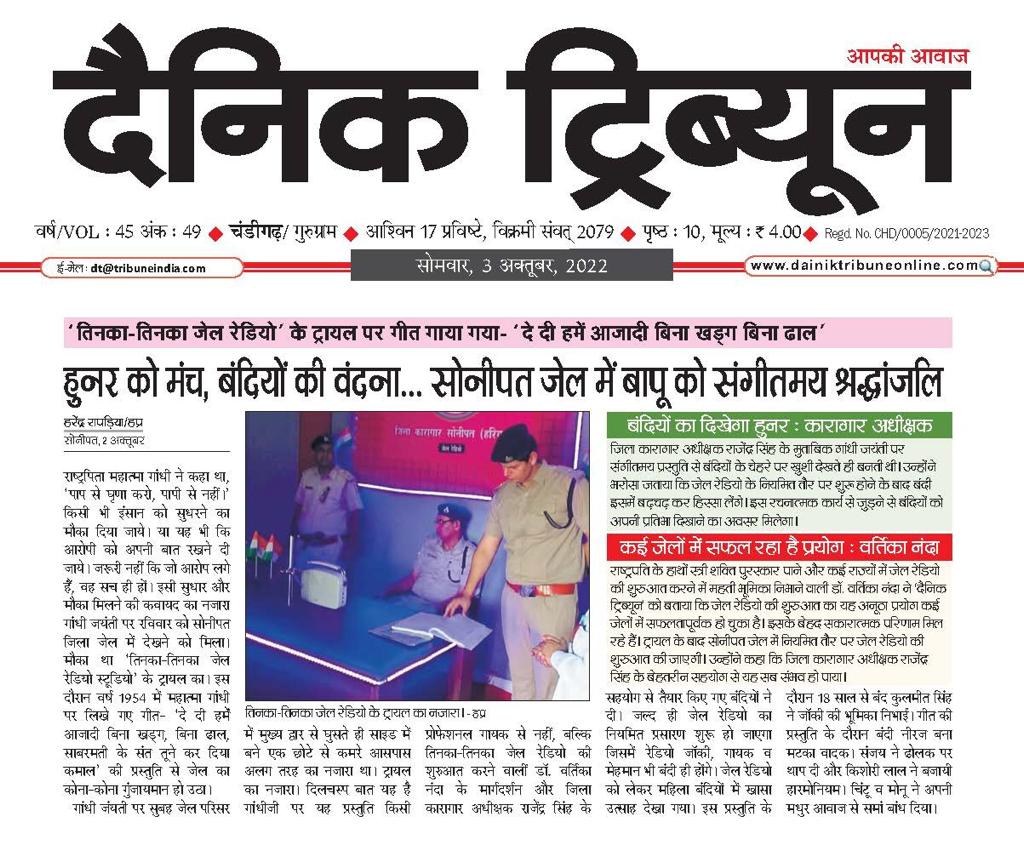
जेल सुधारक, शिक्षाविद और तिनका तिनका फाउंडेशन की संस्थापक डॉ. वर्तिका नंदा के सहयोग से वर्ष 2021 में सोनीपत जेल में रेडियो स्टेशन शुरू हुआ था। जिसके बाद सोनीपत स्टेशन में रविवार को पोस्टकार्ड सेवा शुरू करने के साथ दो महिला रेडियो जॉकी की व्यवस्था की गई है। अब बंदी या कैदी पोस्टकार्ड पर अपना नाम व बैरक लिखकर अपने पसंद के गाने, भजन व रागनी को रेडियो स्टेशन से बजवाने के लिए भेजेंगे तो उसे महिला रेडियो जॉकी बजाएंगी।
डॉ. वर्तिका नंदा ने कहा कि सोनीपत स्टेशन से शुरू की गई पोस्टकार्ड सेवा से बंदियों में पढ़ने-लिखने की भी रुचि पैदा होगी। उनका कहना है कि तिनका रिसर्च सेल भी बनाया गया है। जिसका फायदा मिल रहा है। सोनीपत के जेल अधीक्षक राजेंद्र सिंह का सदैव सहयोग मिला है।
साढ़े चार घंटे जेल रेडियो स्टेशन से बजते हैं गाने, भजन और रागनी
सोनीपत जिला कारागार में बंद करीब 1300 बंदी रेडियो स्टेशन का लाभ ले रहे हैं। इनमें करीब साढ़े 12 सौ पुरुष व 60 महिला बंदी शामिल हैं। रेडियो स्टेशन को सुबह साढ़े नौ बजे शुरू किया जाता है। जिस पर साढ़े तीन घंटे तक गाने, रागनी, भजन, गुरुवाणी व दिन विशेष को लेकर सूचना प्रसारित की जाती है। फिर शाम को पांच से छह बजे तक रेडियो स्टेशन पर भजन संध्या होती है।
महिला बंदी एक घंटे के लिए आएंगी रेडियो स्टेशन
सोनीपत कारागार के रेडियो स्टेशन पर जल्द नई पहल शुरू होगी। अब दो महिला बंदी भी रेडियो जॉकी की भूमिका निभाएंगी। इसके लिए प्रयास शुरू हो गए हैं। महिला बंदी एक घंटे के लिए रेडियो स्टेशन में आएंगी और बंदियों-कैदियों के लिए रेडियो जॉकी की भूमिका निभाएंगी। इसके लिए कारागार में विशेष व्यवस्था की जाएगी। महिला बंदियों के रेडियो स्टेशन में कार्यक्रम प्रसारण के दौरान अन्य बंदियों को उनकी बैरक में रखा जाएगा। इसके साथ ही कारागार पर अपनी माताओं संग रह रहे बच्चों को भी गाना या अन्य कार्यक्रम जेल रेडियो के माध्यम से प्रसारित करने के लिए प्रेरित किया जाएगा। कारागार में पांच बच्चे अपनी माताओं के साथ रहते हैं। जिनमें से एक छोटा बच्चा है। अन्य बच्चों को कविता पाठ या अन्य कार्यक्रम प्रस्तुत करने के लिए प्रेरित किया जा रहा है।
कारागार के ‘मास्टरजी’को दिया तिनका-तिनका इंडिया अवॉर्ड
जिला कारागार में अपने दस साथियों के साथ मिलकर जेल रेडियो स्टेशन चला रहे मास्टरजी के नाम से पहचान बना चुके कुलजीत को तिनका तिनका इंडिया अवॉर्ड दिया गया। डॉ. वर्तिका नंदा ने रेडियो स्टेशन में पहुंचकर उन्हें यह अवॉर्ड दिया। कुलजीत के बेहतर प्रयासों से बंदी लगातार सीख ले रहे हैं। इस दौरान जेल अधीक्षक राजेंद्र सिंह ने भी कारागार में की जा रही बेहतर पहल की सराहना की।
जेल से बाहर जाकर संगीतकार व गीतकार बनूंगा
कारागार में रेडियो स्टेशन के बंदी ने बताया कि जेल से बाहर जाकर संगीतकार और गीतकार बनूंगा। जेल में आने का पछतावा हुआ है। पहले सारा दिन गुस्से में रहता था। अब सभी से प्यार से बात करता हूं। अब परिवार वाले भी प्यार से बात करते हैं।
जेल रेडियो स्टेशन शुरू होने से कारागार के अंदर का माहौल बदल रहा है। रोजाना करीब साढ़े चार घंटे के प्रसारण के दौरान जेल में बंद कैदियों और बंदियों की रुचि के अलावा जागरूकता कार्यक्रमों का भी प्रसारण किया जाता है। इन कार्यक्रमों से उन्हें अवसाद की ओर जाने से रोकने में मदद मिलती है। -राजेंद्र सिंह, जेल अधीक्षक, सोनीपत
_______________________________
Courtesy: Amar Ujala
Dainik Tribune: https://www.dainiktribuneonline.com/news/haryana/tinka-tinka-jail-radio-is-changing-the-life-of-prisoners-148433
_______________________________
April 9, 2023: A visit to District Jail, Sonipat (Haryana) to evaluate progress of Tinka Jail Radio
जेल में रेडियो बंदियों को रौशनी देगा। उनमें शिक्षा पाने की उत्सुकता को सींचेगा। उनकी कलात्मकता को निखारेगा। इसी मंशा के साथ 2020 में हरियाणा में तिनका जेल रेडियो की नींव रखी गई थी। उसका असर अब दिखने लगा है। कल जिला जेल, सोनीपत में थी। बीज को एक वृक्ष के तौर पर पल्लवित होते देख रही हूं। जेल के सुपरिटेंडेंट श्री राजेंद्र कुमार और असिस्टेंट सुपरिटेंडेंट किशोरी लाल जी ने जेल को नया चेहरा दे दिया है। जेल रेडियो के कमरे में खड़े होकर एक नई शक्ति महसूस होती है। ईश्वर की अनुकंपा है कि जेल की इन सलाखोंं में अब शिक्षा और संगीत के लिए जेल का रेडियो बड़ी भूमिका निभा रहा है।
.jpg)

April 10, 2023: आज यह खबर तीन अखबारों में प्रमुखता से छपी है। इन पत्रकार साथियों का आभार। नंदकिशोर भारद्वाज: ब्यूरो चीफ, दैनिक जागरण, सोनीपत/ रविंद्र कौशिक: ब्यूरो चीफ, अमर उजाला, सोनीपत/ हरेंद्र रापड़िया़: जिला प्रभारी संवाददाता, दैनिक ट्रिब्यून, सोनीपत


Promo of Episode 65:
April 7, 2023
Have you ever thought about what freedom is? For the answer you can look around and see the birds flying high up in the sky. Well, it was a philosophical meaning of what freedom is, the real meaning of freedom is the state of independence where one can do whatever one likes without any restriction by anyone. Moreover, freedom can be called a state of mind where you have the right and freedom of doing what you can think of . Also, you can feel freedom from within.
The term freedom is very common and heard by everyone but if we seek for the exact meaning then it will differ from one person to another, there will be plenty of answers for this, some will say speak up for themselves, for some it is the liberty to do anything and everything in their life they like.

Have you ever wondered what freedom for a prisoner is? We never bothered about it as individuals, but Tinka Tinka Foundation (TTF) does, founded by Dr. Vartika Nanda, TTF is trying to give freedom of expression to jail inmates through various modes, like the Tinka Jail Radio. Tinka Tinka movement gives a light of hope to those who were hopeless and motivates people to look forward in their life.
The Tinka Tinka movement became a medium for prisoners to express themselves in a most creative way, some became artists, some became radio jockeys of radio stations which were started in their respective prisons. The Tinka Tinka Foundation is giving wings of knowledge and expressions to these inmates. For birds, sky is the limit but for an individual it's their thoughts who makes them break all the ceiling of glass between them and the sky.
An individual cannot change their past. The only thing that can be done is to look forward in their life and work for a change, a better change.
Promo of Episode 64:
March 2023
Doordarshan has touched our life from many generations and the present generation is not untouched. So everyone wants to visit it at some point in their lives. Doordarshan invites students all over the world to visit the establishment and experience the vibes of the National Broadcaster of India.
In the same context First year students of B.A. (Digital Media & Design) from DSEUS Delhi Skill and Entrepreneur University, Mayur Vihar Campus, Delhi visited Doordarshan News and were explained the nuances of NEWS and News production. The Man talking to them was ace IIMCian and Senior Officer of Indian Information Service, Assistant Director (News) Mr. Manoj Roorkiwal . Mr. Manoj has worked with Press Information Bureau, Office of the Registrar of Newspapers, Photo Division, Directorate of information & Publicity GNCT Delhi. Mr. Manoj told them about the history of Doordarshan and its relevance in present day. Later on, he took them around while showing the working of the Newsroom, Production Control Room, Studio and providing first-hand information of DD News. He also made them meet the Anchors, Editor in Chief, Bulletin Editors, Packaging personnel, news producers in Newsroom and technicians, sound recordists in Production Control Room. He also took them to studio where he passionately explained about the nuances of studio where he told them about backdrop, video wall, camera setup, lighting, set and the whole set up of the studio with live demonstration. The students were very excited to see the working of a news channel and were seen asking questions enthusiastically.


Change is the only constant – Heraclitus


Paper: Reporting and Editing for Print
Semester: 2
Class Report (28.03.2023, Tuesday)
After three vivacious days of merriment and joy at the annual college fest ‘Tarang’, the students of Lady Shri Ram College went back to their timetables and academic schedules on Tuesday, 28th March, 2023. First year students began with their second semester at college. The first class, for Journalism students was of the Paper ‘Reporting and Editing for Print Media’ which is taught and mentored by Dr. Vartika Nanda (HOD Journalism).
The class began with our professor asking for feedback on our recently given semester end exams for Semester-1. The students shared their experiences and learnings after writing a university-level exam for the first time. Vartika ma’am also discussed the importance of Internal Assessments (IA) and their valuable impact academically. It was emphasized that students should keep in mind the major learnings while moving ahead in the new semester.
We then proceeded to discuss the syllabus for this semester (Sem-2) which includes 3 units, i.e.: Covering News and Interviewing, Newsroom and Anatomy of a Newspaper and Issues and Trends in News reporting-in detail. Readings for each unit were then listed and discussed. The class was then divided into various groups based on their skill set and interest to work in different teams, namely Research, Content Writing, Blog Writing, Social Media Marketing, Designing, calligraphy, poster designing, PPTs and the Library Team- for department related work. Library Team was asked to look for readings in the Library and report back to ma’am the following day. Apart from the previously set teams, ma’am also talked about sub-teams that would focus on research pertaining for media education and cinema. Book reviews were also discussed at length.
With this, the teacher also announced the re-activation of the Media Research Cell (MRC)-established by her in 2021. This cell caters to journalistic research and innovation within and outside college. For this, the class inclusively discussed ways to take in new members and select team coordinators, for the efficient functioning of the cell. The class decided on a group discussion round to be the method of selection for the Team leader(s) or head(s). The date for the group discussion hasn’t been finalised yet.
This discussion led the class to the possibility of organising our department work in ways that can get us to collaborate with other like-minded institutions for the overall development of students and for greater outreach of journalistic issues. We then decided on holding inter and intra- college competitions-which would entail audio-visual, print and online submissions on various topics.
Vartika ma’am also expressed her wish for interested students to take up social outreach campaigns and programmes, if they wish to do so. Students were asked to brainstorm ideas and get back to ma’am.
________________________________________
2023: The following research paper is published. This is part of Tinka Prison Research Cell established by Vartika Nanda on 27th April, 2021. This paper is based on research conducted in District Jail, Karnal. Details to follow soon.
करनाल जेल रेडियो: तिनका रेडियो का बंदियों पर प्रभाव और उनकी पसंद के गाने
